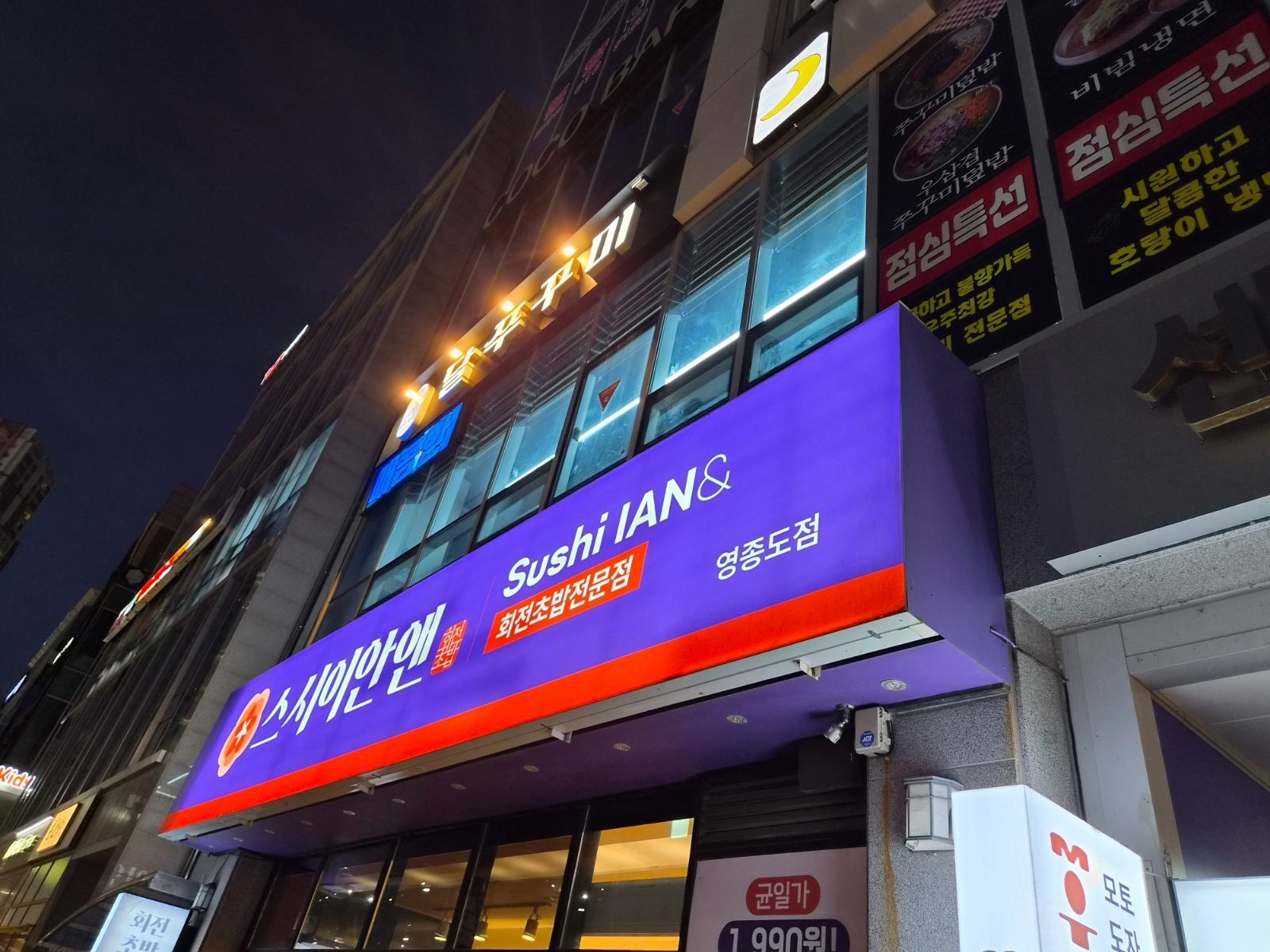
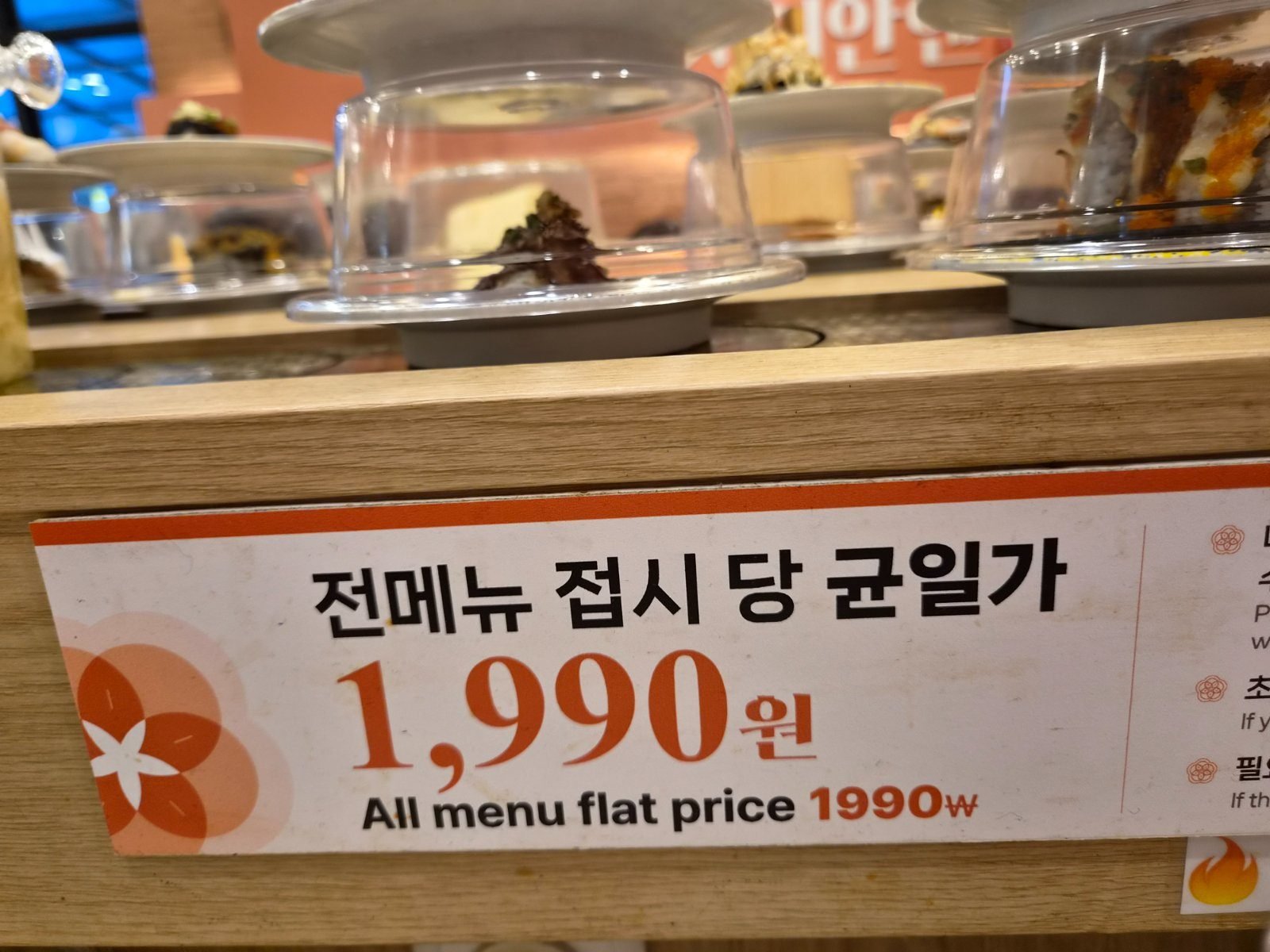
The short answer: regular belt plates at Sushi IAN& (스시이안앤) were ₩1,990, while boxed Special Sushi counted as two plates and noodle sides cost extra. The recorded taxi trip from Terminal 1 is about 20 minutes. It is a conveyor belt sushi counter in the Sky City district of Yeongjong, the island Incheon Airport sits on. You sit down, take what goes past, and stop whenever you want — which makes it the easiest sit-down meal to fit into a layover, because you decide when it ends. Prices seen in August 2026.
Stay inside the airport on a connection under five hours. With more time, decide after arrival formalities: the remaining time must cover this meal, the return journey, any baggage errands and your airline’s deadlines.
Why sushi rather than a Korean meal?
Because of the exit. Most restaurant meals on this island commit you to a length — the tteokbokki buffet in the same Sky City district has you boiling your own pot and finishing with fried rice, and that is an hour minimum whether you like it or not. A conveyor belt has no such shape. You can eat four plates and go, or fourteen. If your gate time is a moving target, that difference matters more than the food does.
The other reason is arithmetic: count regular plates at ₩1,990, count each boxed Special Sushi item as two plates, and add separately priced sides. The photographed August 2026 menu below shows the exception; ask staff if a dish is unclear.
How much time does it take?
The eating is the short part. Everything around it is what you have to budget for.
| Step | Good day | Bad day |
|---|---|---|
| Deplane and walk to immigration | 10 min | 25 min |
| Immigration queue | 25 min | 90 min |
| Bags and storage | 0 min | 55 min |
| Taxi to Sky City | 20 min | 30 min |
| Sit down, eat, pay | 40 min | 60 min |
| Taxi back to the terminal | 20 min | 30 min |
| Security, immigration, gate | 35 min | 90 min |
| Total | ~2 hr 30 | ~6 hr 20 |
The immigration queue is the line that decides the whole table, and it is the one you cannot control. The full arrival timings behind these numbers sit in my guide to leaving Incheon Airport on a layover, including how far the foreign-national queue has run at summer peak.
The short scenario is about two and a half hours, but the longer one is about six hours twenty. Neither is a measured minimum or maximum. Do not use the short case to declare four and a half or five hours comfortable; allow separately for omitted waits and the boarding cutoff.
How do you get to Sushi IAN& from the terminal?
Take a taxi. These are the figures I looked up on 2 September 2026:
| From | By taxi | Distance | Fare |
|---|---|---|---|
| Terminal 1 | 20 min | 14.2 km | ₩14,900 |
| Terminal 2 | 22 min | 19.8 km | ₩18,900 |
| Unseo station (운서역) | 14 min | 10.7 km | ₩12,500 |
| Yeongjong station (영종역) | 12 min | 5.1 km | ₩7,900 |
If you would rather pay ₩1,500 than ₩14,900, bus 202 leaves Terminal 1 from platform 13B on the first floor and runs 42 minutes to the 힐스테이트 (Hillstate) stop, about three minutes’ walk from the restaurant. No transfer. I do not have its frequency, so check the next departure in Naver Map before you commit to it — an infrequent bus at the wrong moment can cost you more time than the taxi saved you in money.
The address, for pasting into Naver Map or handing to a driver: 인천 영종구 하늘별빛로65번길 19 101, 102호 (19 Haneulbyeolbit-ro 65beon-gil, Yeongjong-gu, Incheon, units 101–102). Copy the Korean line rather than the romanisation, which does not return the place. For checking where it sits on a map before you travel, Sushi IAN& has a pin on Google Maps; for directions, opening hours and the bus, use Naver Map.
Leave the suitcase behind. Staffed luggage-storage options at Incheon Airport cost less than the taxi does, and a conveyor counter is a tight place to park a large case.
How does a Korean conveyor belt sushi restaurant work?
You sit at the belt. Plates come past under clear covers; you lift the cover and take the one you want. Regular belt plates were ₩1,990 regardless of plate colour. Boxed Special Sushi counts as two plates, so the bill is based on chargeable plate units, plus any separately priced sides.
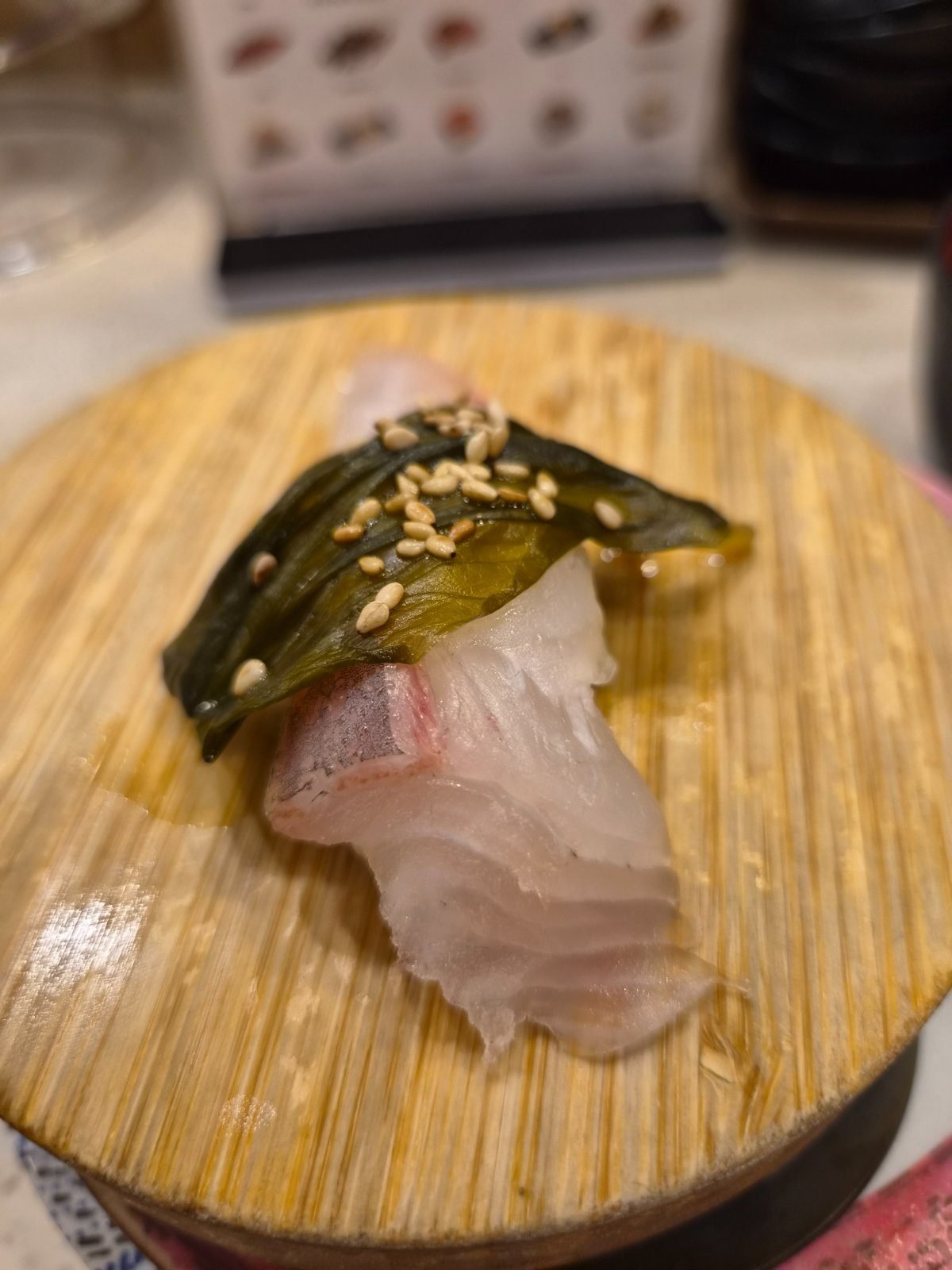
The part that makes this place better than the other conveyor counters I have tried recently: if what you want is not coming round, you can say so and they make it, more or less on the spot. I asked for the white fish with kelp on top and it arrived without any wait worth mentioning. That turns the belt from a lottery into a menu.
Can you order if you do not speak Korean?
For the belt, yes, and you do not have to say anything at all — you take what you can see. That is the whole appeal for a traveller: no menu, no pronunciation, no waiting to be understood.
There is a standing photo menu on the counter with a picture of every item, so ordering something specific is a matter of pointing. The item names on it are in Korean only, so you will be pointing rather than reading. It runs from flounder, red seabream and salmon through to the special sashimi.
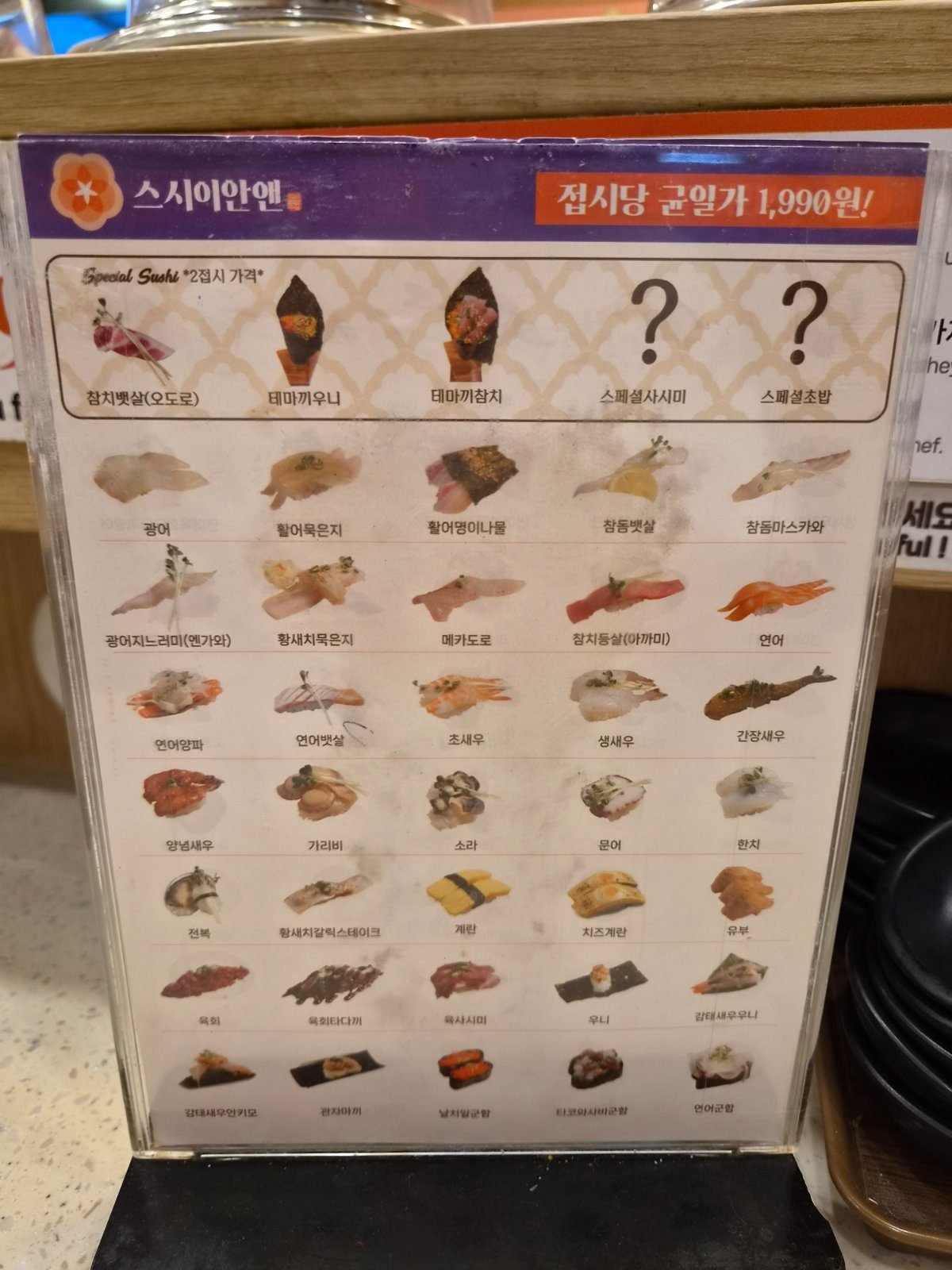
That boxed row is the one thing to check before you point. Everything else on the board is ₩1,990; the specials in the box at the top are charged as two plates. It is written on the menu, but only in Korean, so it is the kind of thing that turns into a surprise at the till if nobody tells you.
Sides are also outside the flat price. Udon was ₩6,900 and cold buckwheat noodles ₩7,900 in August 2026. A hot udon after a stack of cold plates is a good idea, but it is not a ₩1,990 idea.
Check that your own card is accepted before ordering and keep a backup payment option. Water and cutlery are usually self-serve in Korean restaurants; look for the station rather than waiting to be brought them.
What is worth taking off the belt?
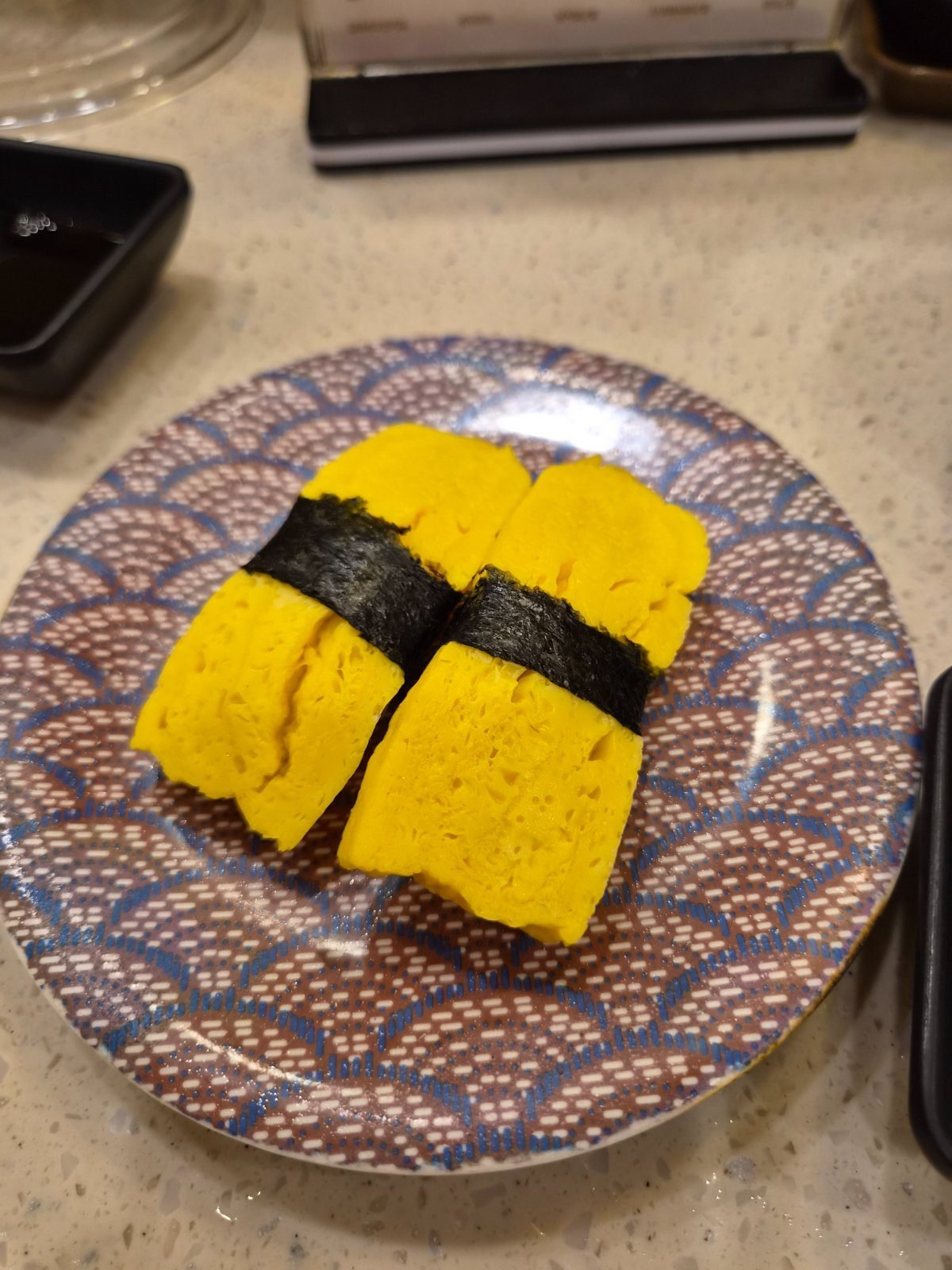
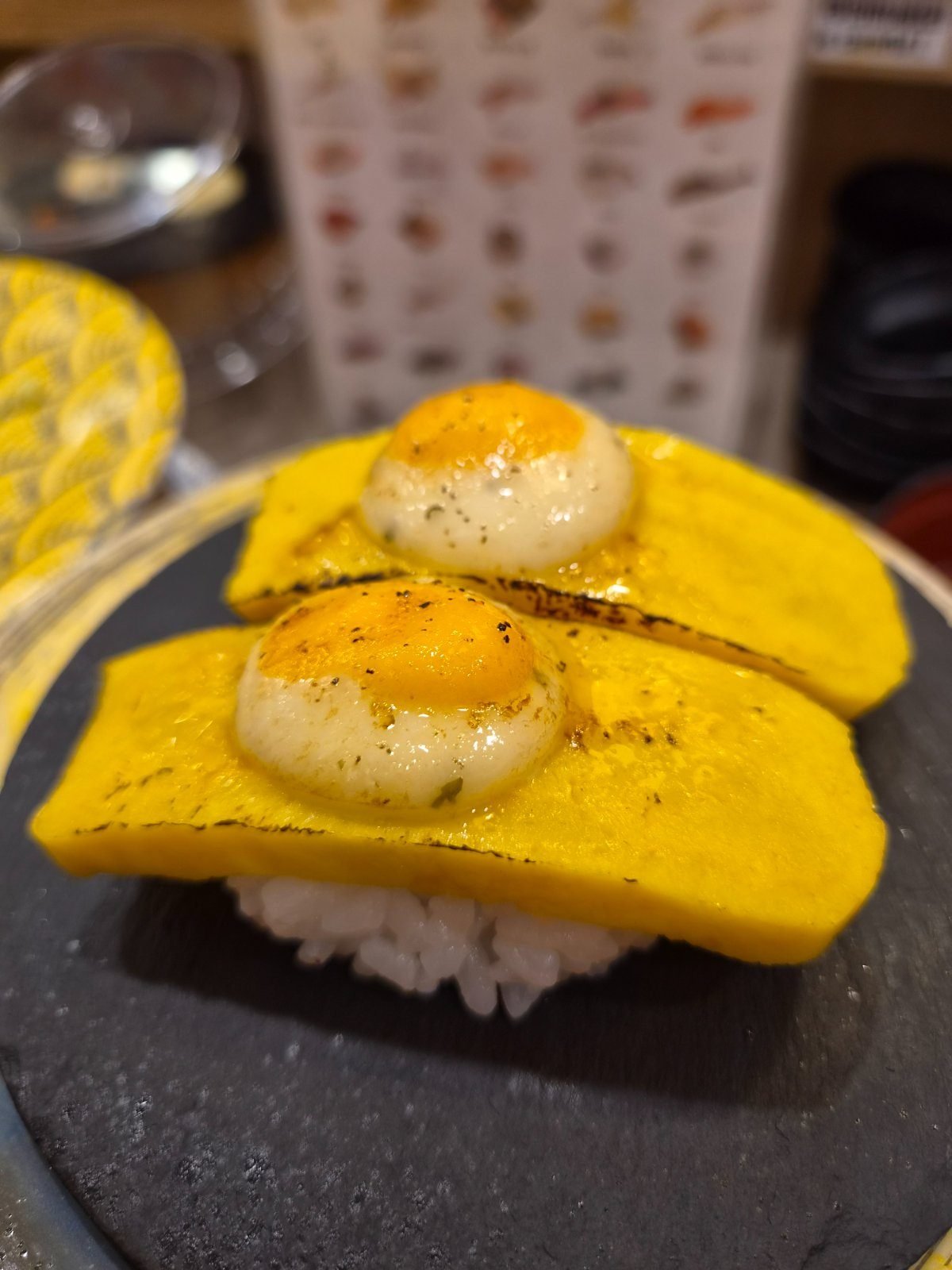
The egg pieces are the reliable ones, and there are two of them. Plain egg is thick and gently sweet. The cheese version puts a disc of cheese on the egg and torches it, salty against the sweet, and it works better as a last plate than a first one.
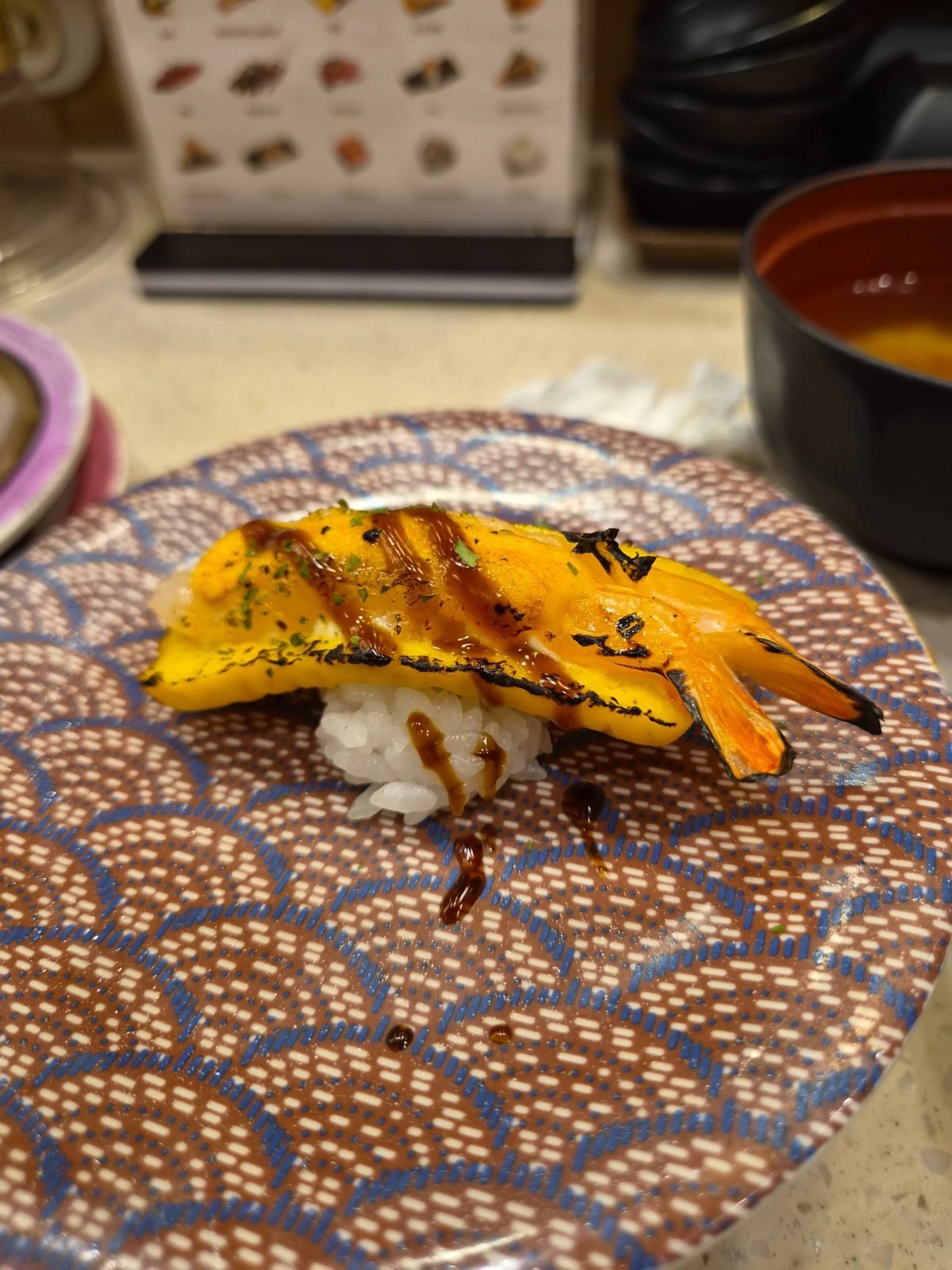
The torched pieces are the ones I would go back for. Egg and shrimp with the surface blowtorched gives you a toasted smell before you taste anything, and the sauce on top pushes the shrimp’s sweetness forward.
The plain white fish was clean, with none of the fishiness that ruins cheap sushi, and two pieces went quickly. The salmon topped with wasabi-seasoned flying fish roe has a popping texture that is more fun than it sounds.
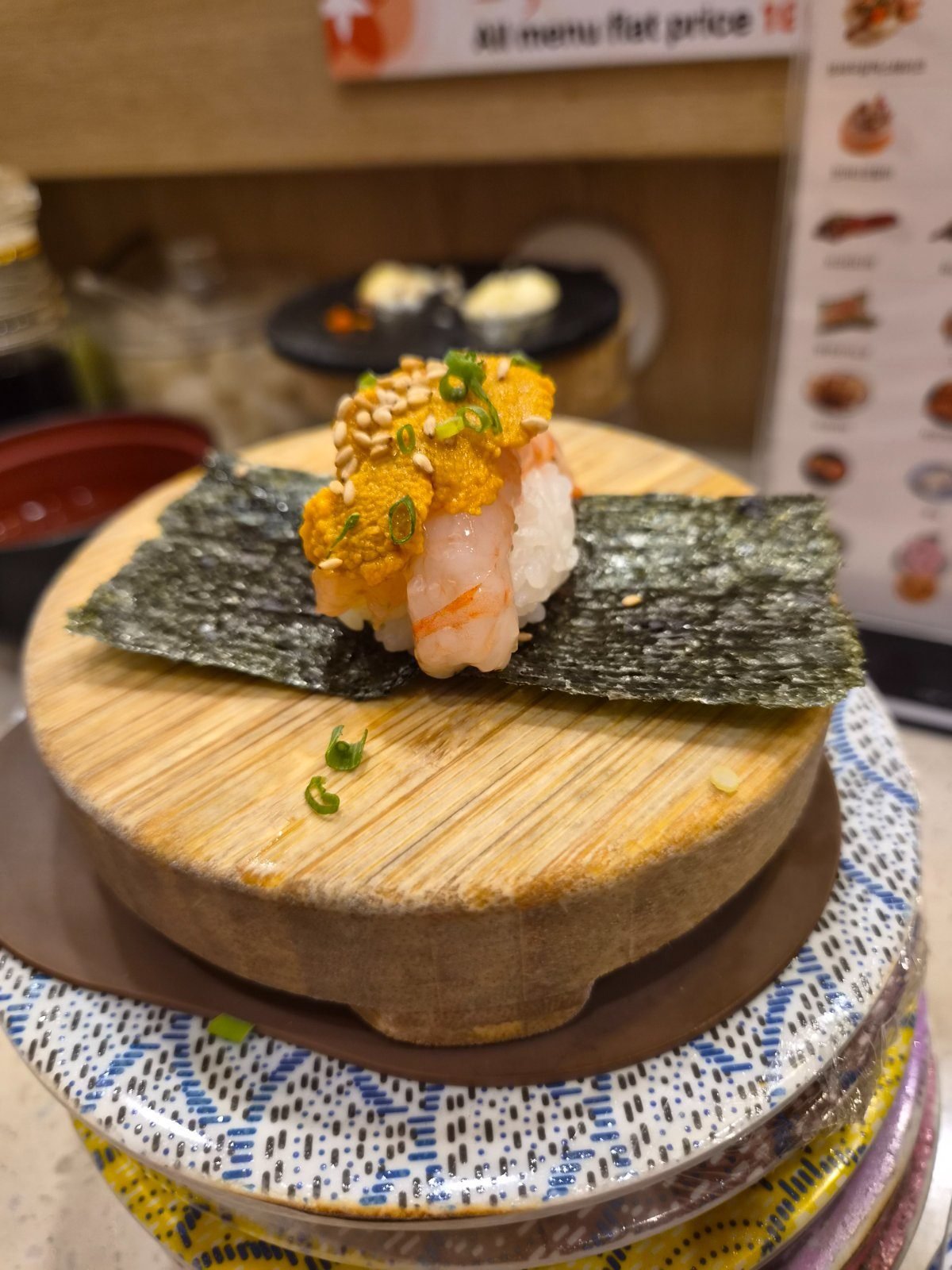
Two I would flag rather than recommend. The white fish under the dark kelp and thick sauce is heavily seasoned — good if you want savoury depth, wrong if you came for clean fish, and I can see people going either way on it. And the shrimp with monkfish liver on seaweed is a strong, particular flavour. It was not fishy, but it is not a beginner’s plate.
One practical note for anyone who does not eat chilli: I do not either, and I ate a full meal here without having to check anything. Sushi is one of the few Korean restaurant meals where that is true by default, which is not something I can say about the kimchi stew houses on this island.
When should you not go?
Weekend evenings. I went on one and the room was full of families, with a wait to get a seat. It was not a long wait, but a wait of any length is the wrong thing to hit when your margin is a flight. On a layover, aim for the middle of the afternoon or a weekday.
I also do not have the opening hours to give you, and I would rather leave a gap than guess at them. It was serving in the evening when I went. Before you leave the airport, put 스시이안앤 영종도점 into Naver Map and check the hours for that day — Korean restaurants close on rotating days off, and a closed door 20 minutes from your terminal is an expensive round trip. If you are landing in the small hours instead, the Chinese restaurant near Unseo station that never closes is the safer bet.
Is it worth leaving the airport for?
Consider this only if the time left after arrival formalities covers the outing and departure deadlines. Roughly eight plates plus a udon comes to about ₩22,800 at the recorded prices, or about ₩52,600 including the quoted taxi fares both ways. The transport, not the sushi, makes up much of that cost.
If your connection is under five hours, stay inside. With more time, skip the outing if waiting or the return journey would consume the margin before your airline’s deadlines.
And if what you actually want is volume for the smallest possible number, the ₩10,000 Korean buffet in Unnam-dong beats it on price and loses on flexibility. Two different problems.
FAQ
How much is conveyor belt sushi near Incheon Airport?
Regular belt plates at Sushi IAN& in Yeongjong were ₩1,990, without a colour-based price tier. The exceptions are the boxed “Special Sushi” row on the photo menu, which is charged as two plates, and the noodle sides — udon at ₩6,900 and cold buckwheat noodles at ₩7,900. Prices seen in August 2026.
How long does it take to get there from Terminal 1?
A taxi from Terminal 1 to Sushi IAN& takes 20 minutes over 14.2 km and costs about ₩14,900, checked on 2 September 2026. From Terminal 2 it is 22 minutes and about ₩18,900. Bus 202 from platform 13B on the first floor of Terminal 1 takes 42 minutes for ₩1,500 with no transfer.
Can you eat alone at a Korean conveyor belt sushi restaurant?
Yes, and it is one of the easiest places in Korea to do it. Eating alone carries no stigma here, and a belt counter is built around single seats — you take a few plates, pay for what you took, and leave. Nothing on the belt is portioned for two.
Is there an English menu at Sushi IAN&?
The price sign on the belt is bilingual — “All menu flat price 1990₩” — but the photo menu lists its items in Korean only. In practice this does not matter much, because everything on the belt is visible and the menu is photographs. Point at what you want.
How much layover time do you need for this?
Stay inside on a connection under five hours. Five hours or more is not a guarantee: decide using the time left after arrival formalities and allow for the return trip, waiting, baggage errands and your airline’s check-in and boarding deadlines.