The short answer: yes, if you have five hours or more. 502 Jjigae Maeul (502찌개마을) is 20 minutes by taxi from Terminal 1, and a one-person pot of kimchi stew is ₩11,000. It comes as a jeongol — a shallow hotpot on a lit burner at your table — so you start eating when it comes to a boil, and the broth deepens as it goes. Budget about three hours and twenty minutes door to door. With four hours on your passport stamp, skip it: the taxi alone is forty minutes of the round trip, before immigration.
I have eaten here twice in a month, once with someone and once ordering the solo pot, and the second visit was the one that taught me how to order. That is really what this post is.
How much time do you need for kimchi jjigae near Incheon Airport?
Three hours and twenty minutes, if nothing goes wrong. Most of that is not the meal — it is forty minutes of taxi either side, plus whatever the immigration queue decides to charge you on the way in.
| Step | Allow |
|---|---|
| Deplane, immigration, and out to the taxi rank | 35 min |
| Taxi, Terminal 1 to 502 Jjigae Maeul | 20 min |
| Sit down, eat, pay | 50 min |
| Taxi back to Terminal 1 | 20 min |
| Check-in, security and departure immigration | 75 min |
| Total | 3 hr 20 min |
If you are not sure whether you are allowed out of the terminal at all, or how long the queue back in takes, start with what immigration and re-entry actually involve on an Incheon layover.
How do you get to 502 Jjigae Maeul from Incheon Airport?
The restaurant is in Hanuldosi (하늘도시), the newer residential district on Yeongjong Island, about twenty minutes inland from the terminals. Show a driver this and you are done:
인천 영종구 하늘달빛로 70 · 502찌개마을
| From | By taxi | Distance | Fare |
|---|---|---|---|
| Terminal 1 | 20 min | 14.1 km | ₩14,200 |
| Terminal 2 | 21 min | 20.3 km | ₩18,600 |
| Unseo station | 14 min | 11.2 km | ₩11,800 |
| Yeongjong station | 11 min | 5.6 km | ₩7,800 |
Public transport works but eats your margin. The best combination from Terminal 1 is the Airport Railroad to Yeongjong station (11 minutes), then bus 203 toward Hanuldosi for 24 minutes, then a two-minute walk — about 39 minutes and ₩2,850 with a T-money card. The catch is that island buses run infrequently, so a bus that is due in twenty minutes turns a saving of ₩11,000 into a loss of an hour. Open Naver Map before you commit and look at the actual next departure. On a layover I take the taxi.
If you are dragging a suitcase, leave it at the airport first — the left-luggage desks and lockers in both terminals are cheaper than the hassle.
What is on the menu, and what does it cost?
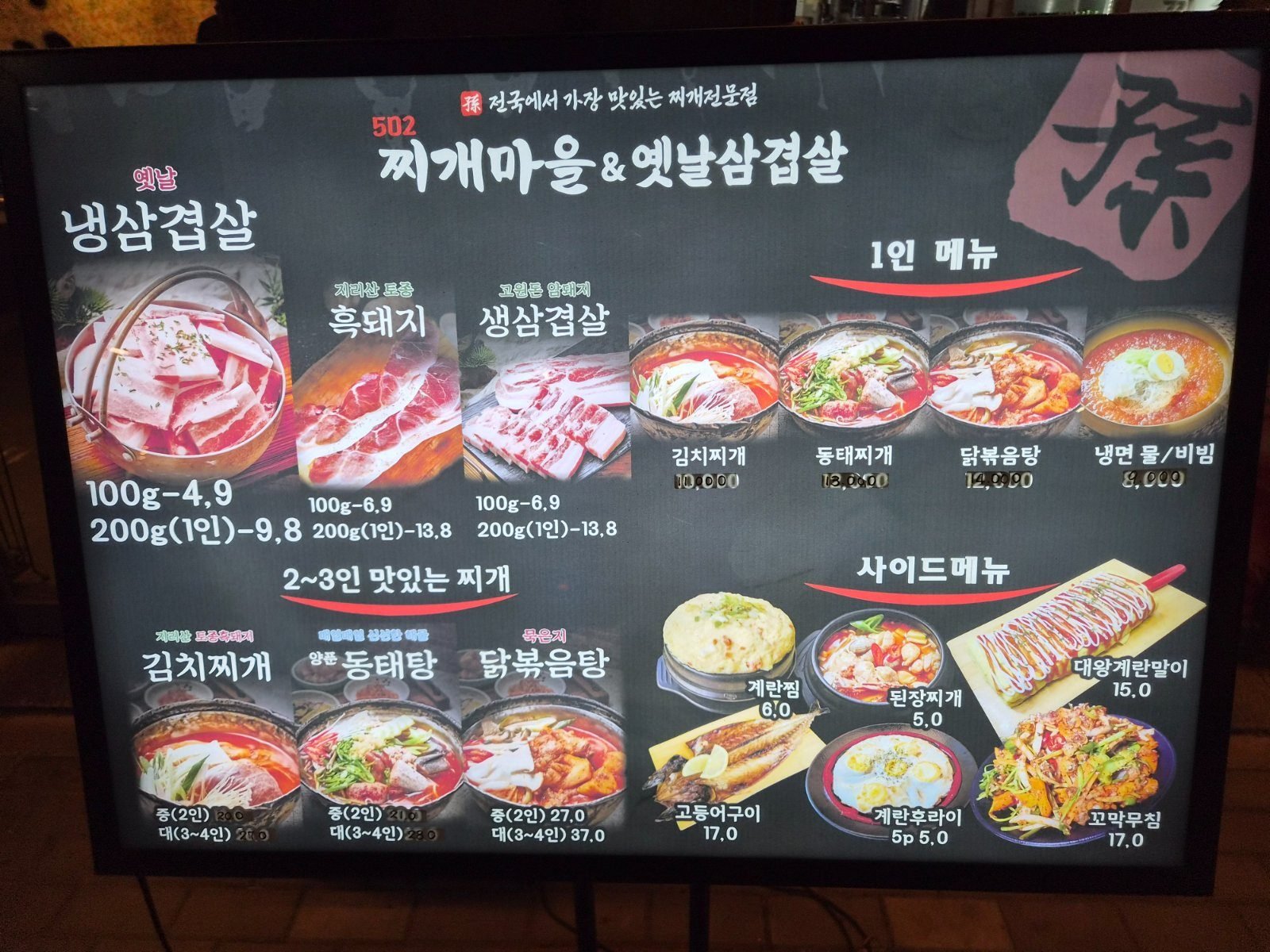
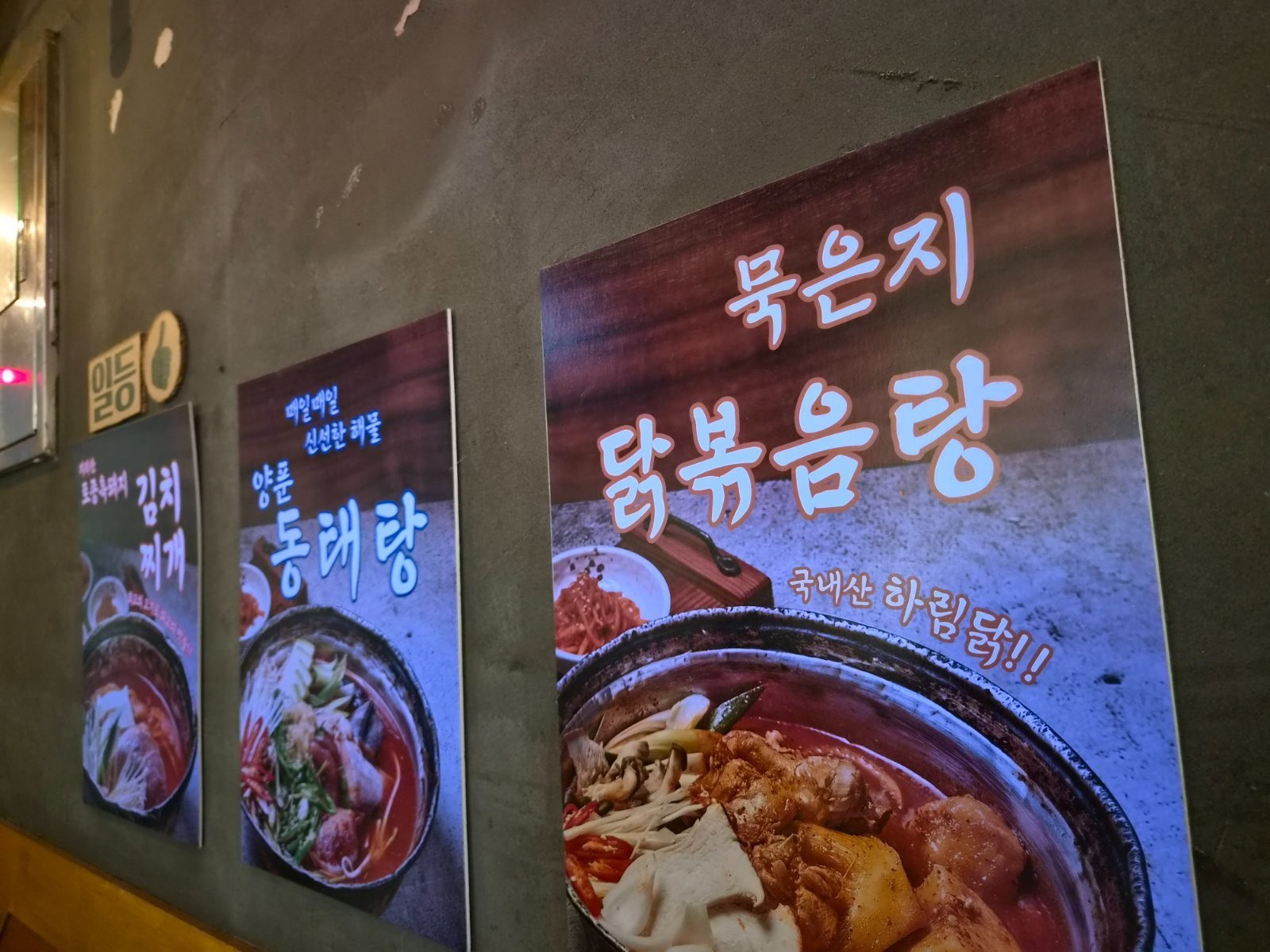
There is no English menu, and there does not need to be. A backlit board stands inside with a photograph of every dish above its price, and three more large photo panels are stuck to the wall by the door. Point at the picture, hold up one finger, and that is the whole transaction.
The important thing on that board is the column headed 1인 메뉴 — the one-person menu. Solo diners are not an afterthought here; they get their own row of dishes at their own prices.
| Dish | Korean | Price |
|---|---|---|
| Kimchi stew, one person | 김치찌개 | ₩11,000 |
| Kimchi stew, medium pot (2 people) | 김치찌개 중 | ₩20,000 |
| Pollack stew, one person | 동태찌개 | ₩13,000 |
| Spicy braised chicken, one person | 닭볶음탕 | ₩14,000 |
| Cold noodles, chilled broth or spicy | 냉면 물/비빔 | ₩9,000 |
| Soybean paste stew (side section) | 된장찌개 | ₩5,000 |
| Steamed egg | 계란찜 | ₩6,000 |
| Giant rolled omelette | 대왕계란말이 | ₩15,000 |
| Grilled mackerel | 고등어구이 | ₩17,000 |
That last line is the one foreigners get caught by. A Korean stew is a shared dish, not a main course, so the rice is a separate order. Say 공기밥 and hold up the number of bowls you want.
What is the kimchi stew actually like?
The first time, two of us ordered the medium shared pot at ₩20,000. It came out cold and heaped — aged kimchi, spring onion and a mound of enoki mushrooms piled above the broth line, with steel dishes of pickled cucumber, yellow radish and dumplings set around it.
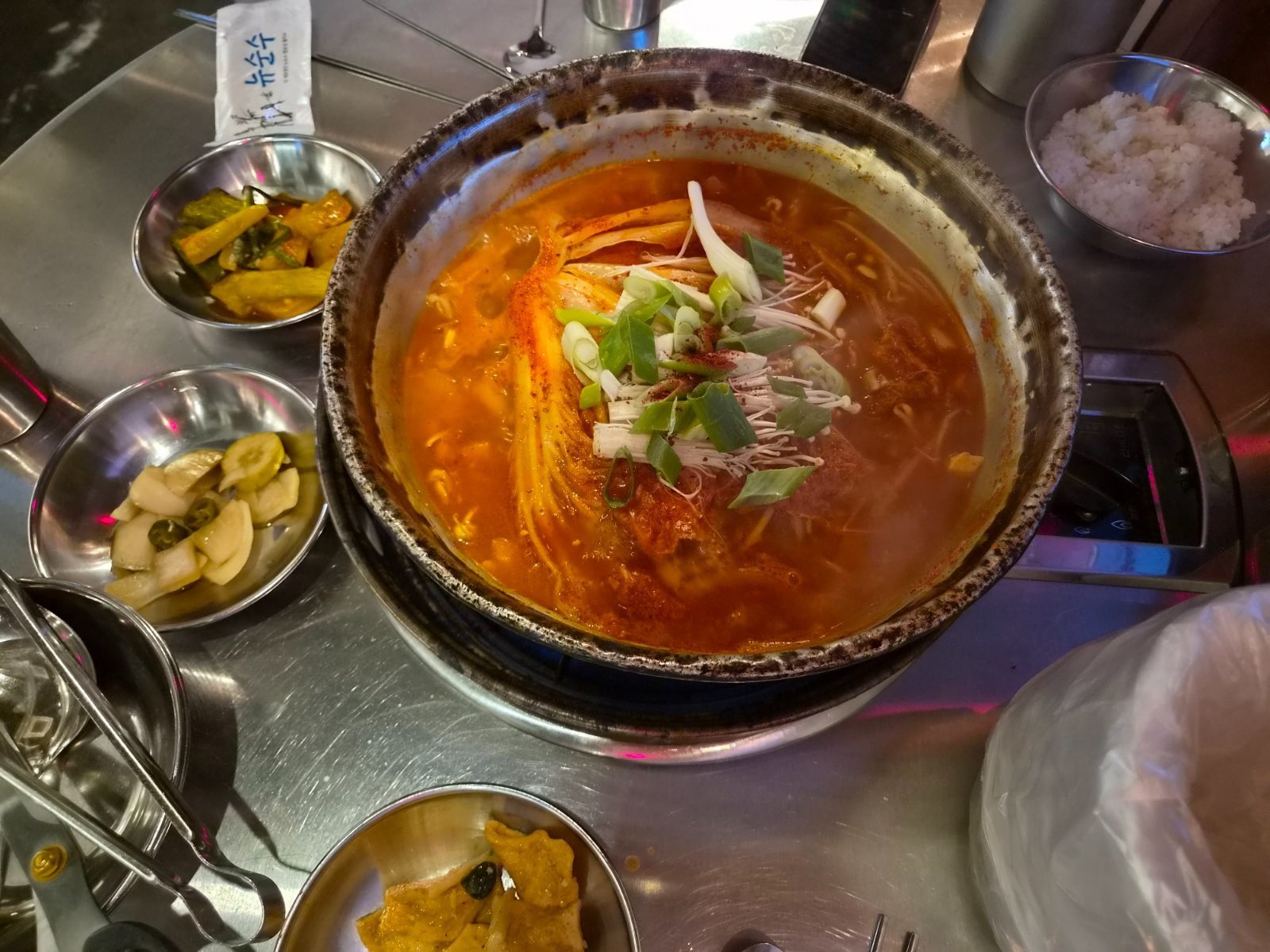
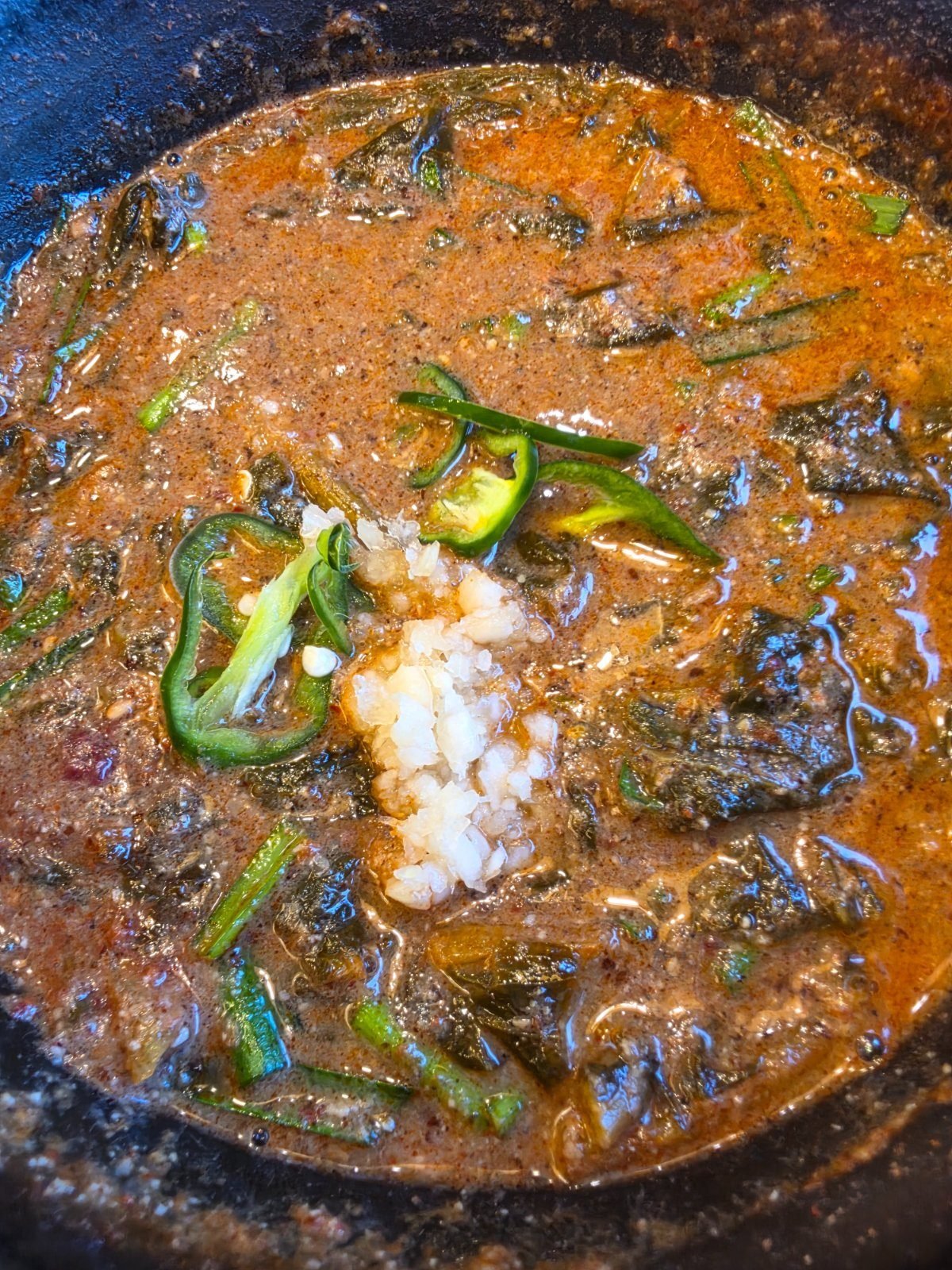
Once it boils the broth turns a much darker red and thickens up. The kimchi is properly aged, so it reads deep rather than sharp — less sour than the kimchi stew you get in a cheap lunch place. The pork is black pork in large pieces you cut down yourself in the pot, and there are bean sprouts in there giving it a clean edge that most kimchi stews do not have.
One honest warning: the broth is seasoned on the salty side. Drinking it by the spoonful is a mistake. It is built to be eaten over rice, or with something bland in it to soften the edge — which brings me to the actual point of this post.
How should you order to not get it wrong?
One-person kimchi stew, extra tofu, and the giant rolled omelette between two people. That is what I landed on after the second visit, and it is the combination I would give anyone walking in cold.
The extra tofu is the part that matters. A thick slab of it sits in the broth soaking up seasoning while blunting the salt, and it turns the pot from something you eat alongside rice into something you can eat on its own. Ask for 두부 추가.
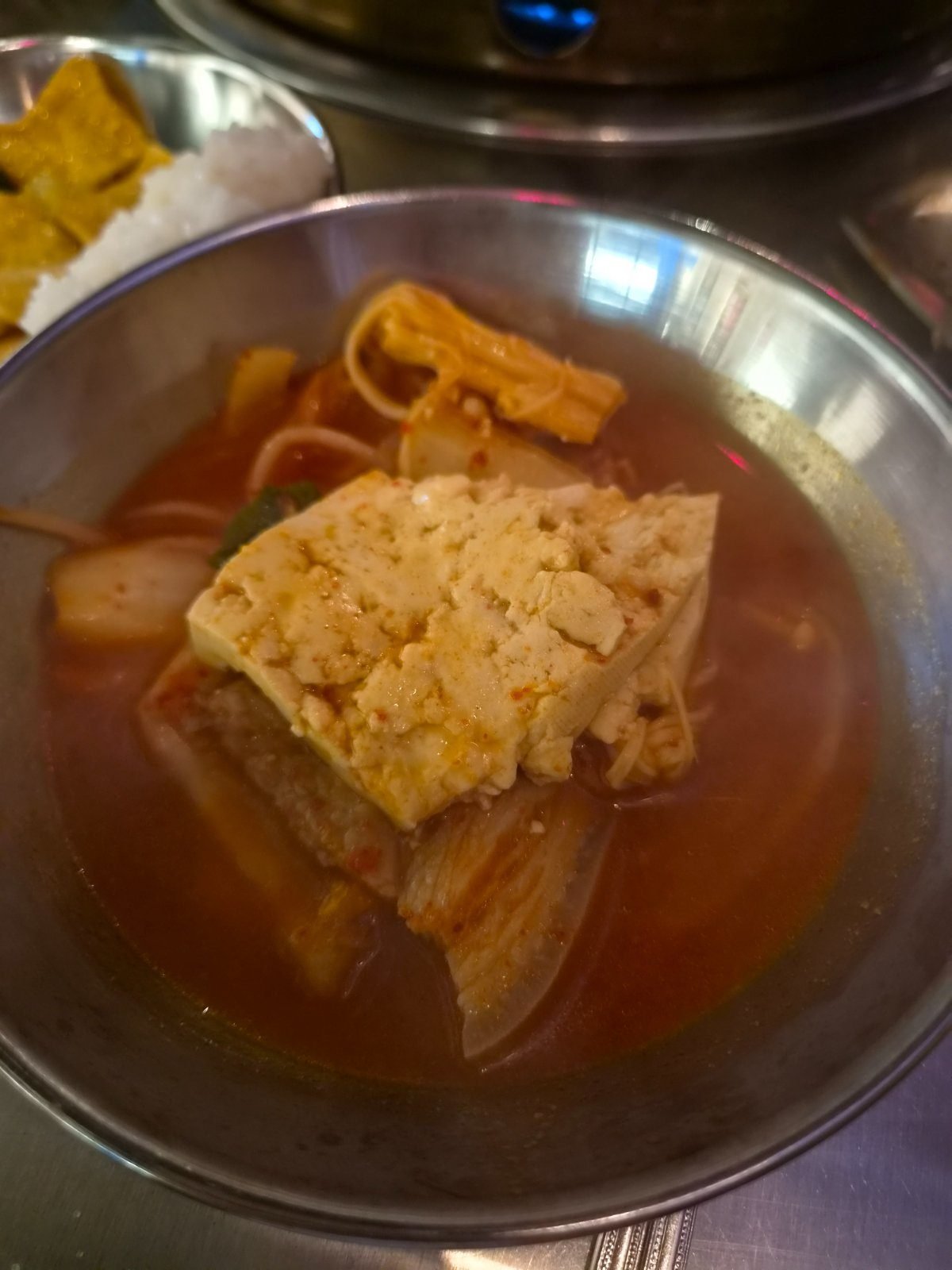
The one-person portion is not a token gesture either. It arrives in a proper pot rather than the small earthenware bowl you might expect, and there is enough in it for a full meal.
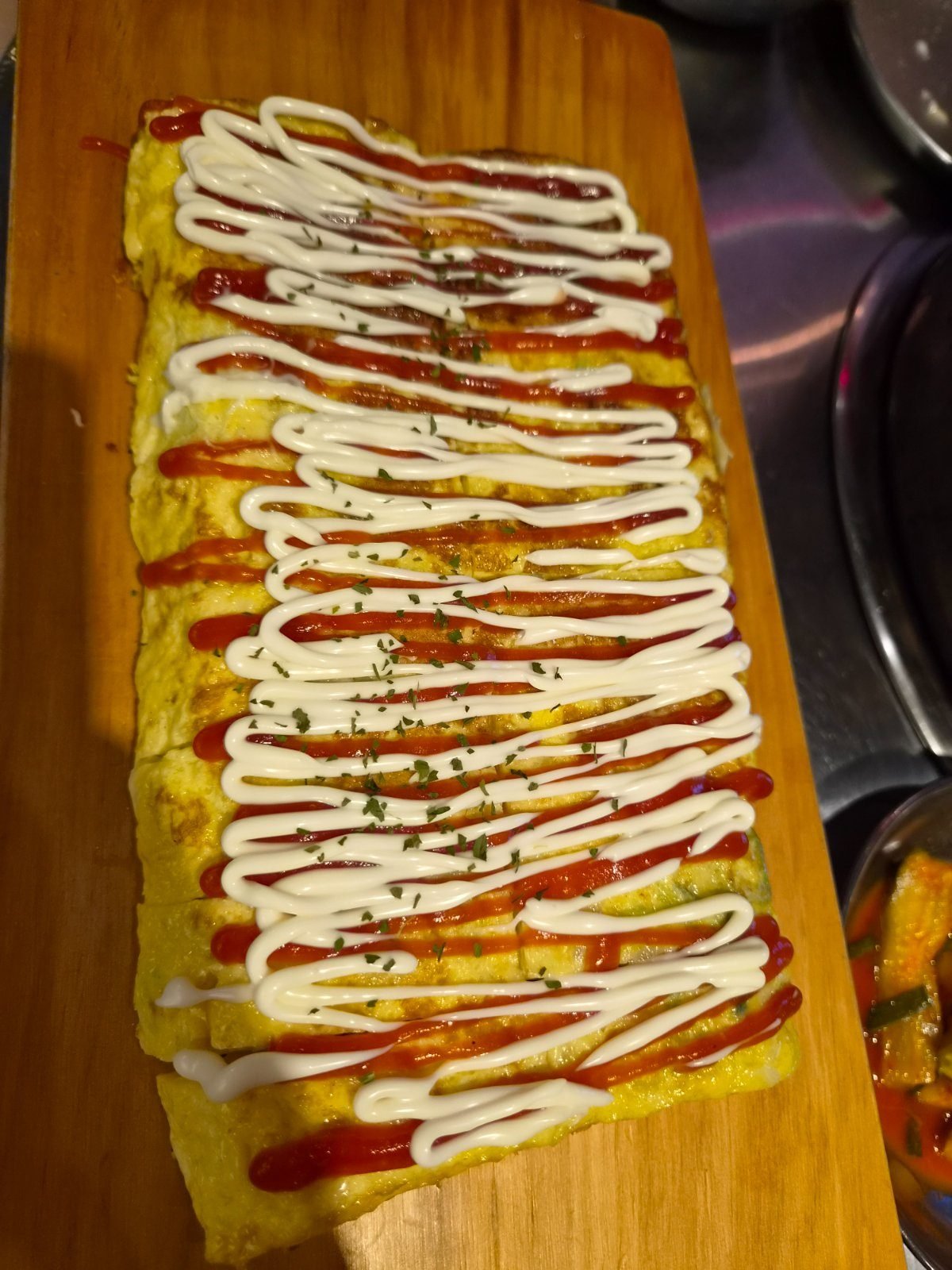
The giant rolled omelette at ₩15,000 is the priciest thing I ordered and the one I would still repeat. It is genuinely large, zigzagged with ketchup and mayonnaise, and moist rather than dry inside. It works as a rice side and as something to pick at, and it is the one dish on this table a child or a nervous eater will finish without argument.
What should you know before you walk in?
The room is an old-fashioned Korean neighbourhood diner — steel tables, gas burners, photographs of stews and cold-sliced pork belly blown up large on the walls. Nobody will look twice at you for eating alone; the menu board has a whole solo column, which is the clearest possible signal.
A few things that are simply true of Korean restaurants and that nobody bothers to tell visitors: cards work everywhere, including foreign ones, so you do not need to hunt for an ATM. Side dishes and water are free and so are refills — ask and they get topped up. There is no tipping and no service charge; the number on the menu is the number you pay. Water, cups and cutlery are often on a rack or in a drawer at the table rather than brought to you.
There is parking in front of the building if you have picked up a rental car.
One thing I cannot promise you is that the doors will be open when you arrive. Many Korean restaurants close for a couple of hours between lunch and dinner, and I have not verified this one’s hours or its day off. Search 502찌개마을 in Naver Map on the morning you go and read the hours off the listing — Google Maps is close to useless for opening times in Korea.
Is it worth leaving the airport for?
With five or six hours, yes — this is a real neighbourhood restaurant, cooking one thing seriously, at a price that would not buy you a sandwich airside. Two people eat properly on a ₩20,000 shared pot before rice.
With four hours, no. The round trip is forty minutes of taxi before you count the immigration queue on the way in and check-in on the way out, and what is left in the middle is not worth the fare. If you want a Korean meal without a taxi at all, there is a clear beef-bone soup place you can walk to from Unseo station, two stops down the Airport Railroad. If you are coming out to Hanuldosi anyway and not everyone you are with eats spicy, the pork cutlet restaurant is a few minutes from here.
I would also skip it if you cannot eat chili at all. Everything the restaurant is known for is red. The cold noodles in chilled broth at ₩9,000 and the soybean paste stew at ₩5,000 are on the board as non-chili options, but ordering those here is like ordering a salad at a steakhouse.
Frequently asked questions
Can one person eat kimchi jjigae at 502 Jjigae Maeul?
Yes. The menu board has a dedicated one-person column and kimchi stew in it costs ₩11,000. It comes in a full-sized pot rather than a small bowl, so it is a complete meal on its own once you add rice.
Is rice included with a Korean stew?
No. At 502 Jjigae Maeul, and at most Korean stew restaurants, rice is a separate order. Say 공기밥 and indicate how many bowls. Side dishes and water, by contrast, are free and refillable.
Does the stew arrive ready to eat?
No. It comes to the table on a lit burner and finishes cooking there. The broth turns a darker red as it boils, and that is the signal to start eating rather than the moment the pot lands.
How much is a taxi from Incheon Airport to Hanuldosi?
About ₩14,200 from Terminal 1 over 14.1 km, and about ₩18,600 from Terminal 2 over 20.3 km, queried on 1 September 2026. Terminal 2 costs noticeably more because the road distance is six kilometres longer, not because it is slower.