The short answer
The hardest part of eating in Korea is not the food. It is the ordering — the Korean-only menu, the waiting staff, the moment where you point at something and hope. At a tteokbokki buffet none of that exists. There is no menu and no order. You take a pot, walk along a counter filling it with whatever you want, choose a sauce, and boil it at your own table.
Dookki in Yeongjong’s Sky City is that, twenty minutes from the terminal. It is a chain, which for once is the point: it is built for people who have never done this before, and the instructions are printed on your table.
Stay inside the airport on a connection under five hours. With more time, check whether this slow, cook-at-the-table meal fits after arrival formalities and before your airline’s deadlines.
How much time does it take?
You are cooking, so this is not a quick stop. Boiling, eating and finishing with fried rice takes time, and that is before you get back.
| Step | Good day | Bad day |
|---|---|---|
| Deplane and walk to immigration | 10 min | 25 min |
| Immigration queue | 25 min | 90 min |
| Bags and storage | 0 min | 55 min |
| Walk to the AREX platform | 8 min | 12 min |
| Train to Unseo, then across to Sky City | 25 min | 35 min |
| Sit down, eat, pay | 60 min | 75 min |
| Back to the terminal | 35 min | 50 min |
| Security, immigration, gate | 35 min | 90 min |
| Total | ~3 hr 20 | ~7 hr |
The longer scenario in the table is around seven hours, so five hours is not a guaranteed minimum for this meal. Use the full airport time budget and your remaining time after arrivals; allow separately for omitted waits and the boarding cutoff.
Getting there
Take the AREX all-stop train to Unseo. From Terminal 1 that is 7–8 minutes and ₩1,200; from Terminal 2, 14–15 minutes and ₩1,800. The express does not stop there.
From Unseo the restaurant is over in the Sky City district, on the second floor of a commercial building. I have not timed that last stretch myself, so put the address into Naver Map rather than trusting a number I have not checked: 인천 영종구 하늘중앙로195번길 15 세영프라자 2층 202호 (15 Haneuljungang-ro 195beon-gil, Yeongjong-gu, Incheon, 2nd floor, unit 202). Copy the Korean line; the romanisation does not return it. Google Maps does not do Korean transit, but the restaurant is on it: Dookki Sky City branch on Google Maps.
Leave the suitcase at the airport. Check staffed luggage-storage locations, prices and hours in your terminal.
How does a tteokbokki buffet actually work?
Four counters and a drinks machine. You visit them in any order and as many times as you like.
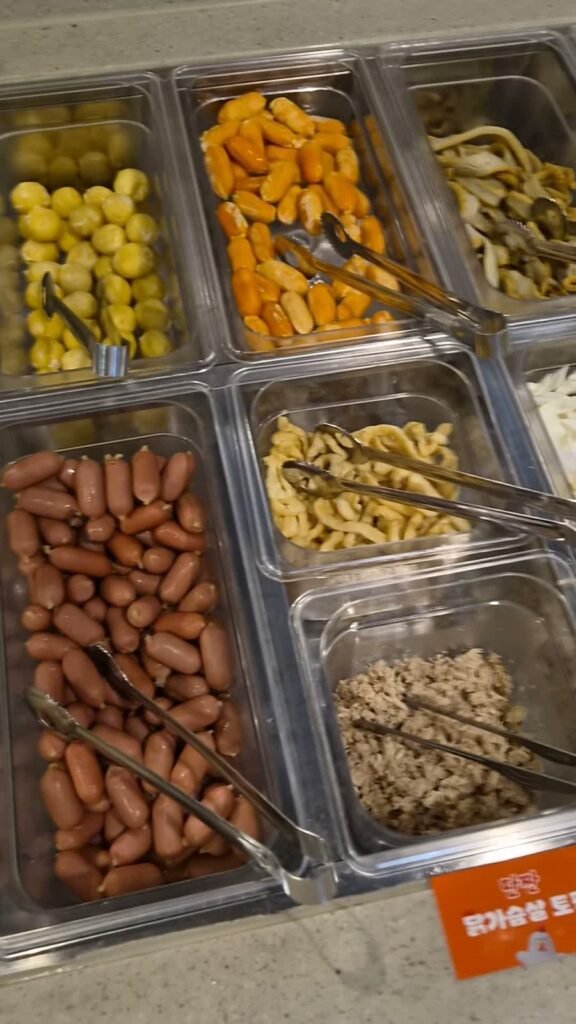
- The ingredient bar. Rice cakes, fish cake, cabbage, tofu skin, enoki and other mushrooms, cocktail sausages, sweetcorn, spring onion, noodles, eggs, tuna. Tongs and a bowl. Fill it.
- The sauce bar. Five bases with labels, plus a recipe posted on the wall.
- The fried counter. Sweet potato tempura, seaweed rolls, vegetable fritters.
- Fish cake skewers sitting in hot broth, with soy sauce and sesame oil beside them.
- Drinks and ice cream, both self-serve. The ice cream is there to put out the fire halfway through, which is smarter than saving it for the end.
Nothing here requires you to speak to anyone or read a menu. That is the whole reason to send a nervous first-timer here rather than to a restaurant where you have to order in Korean.
The instructions are printed on your table
This is the part that makes it work. A Dookki manual sits on the table with the induction settings printed on it.
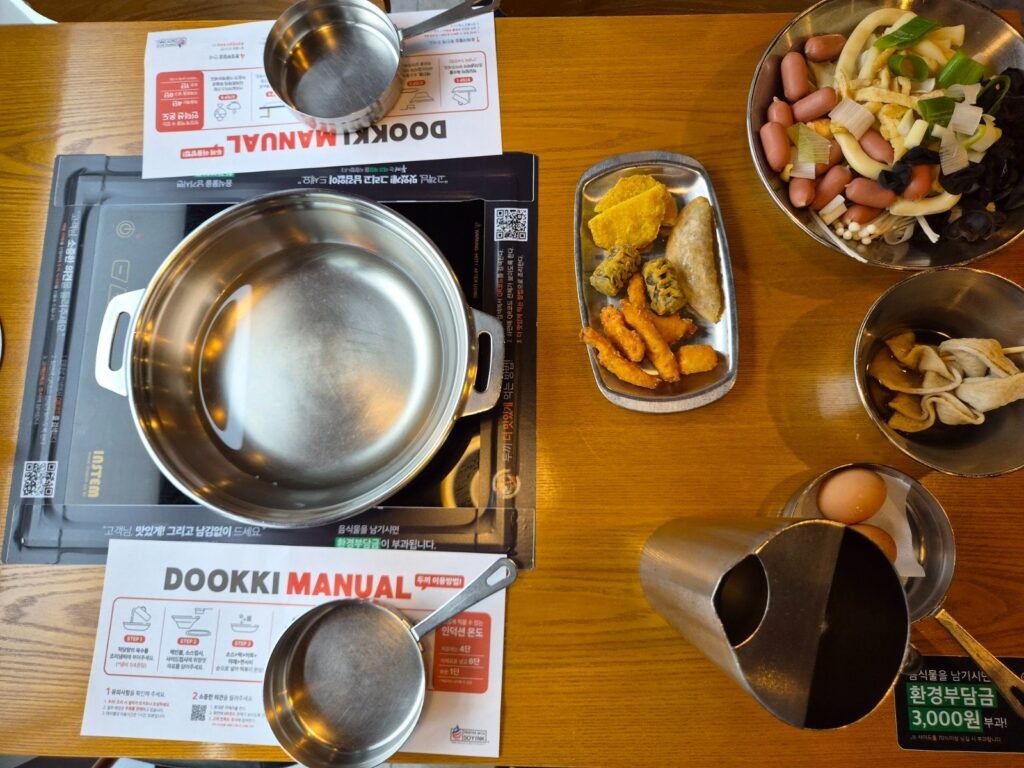
- Pour stock into the pot.
- Fill your main bowl, sauce dish and side plate at the bars.
The induction dial has three settings that matter, and they are printed too: 4 to bring it up, 6 once the ingredients go in, 1 for the fried rice at the end. If your pot is not boiling, you are probably still on 4 with a full pot.
The sauce bar is where the meal is decided
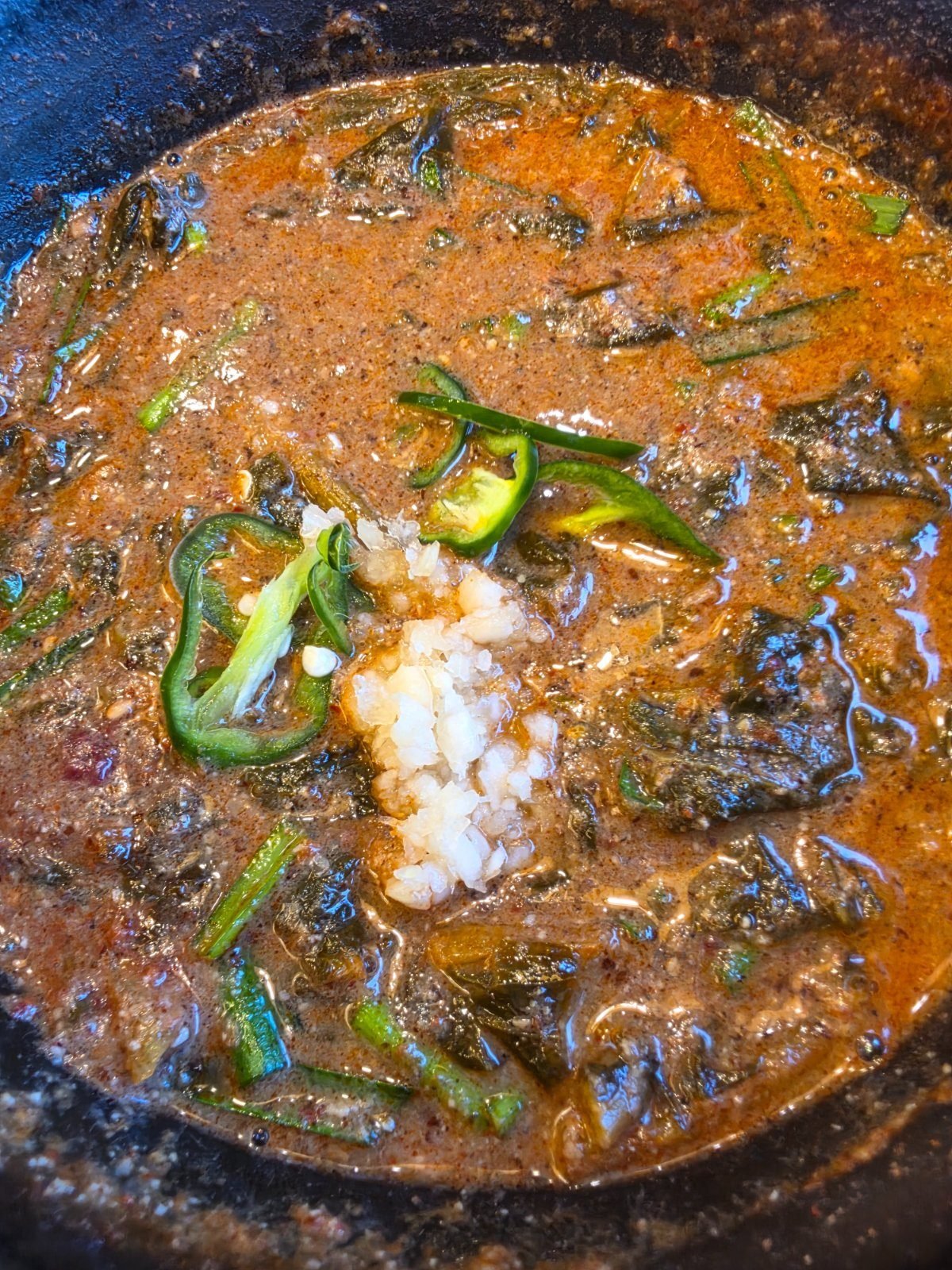
Five bases sit in labelled pots: the house sauce, tteokmo, Dongdaemun, jjajang (black bean) and gungjung. There is a recipe on the wall for a standard mix, and the sensible move is to follow it first.
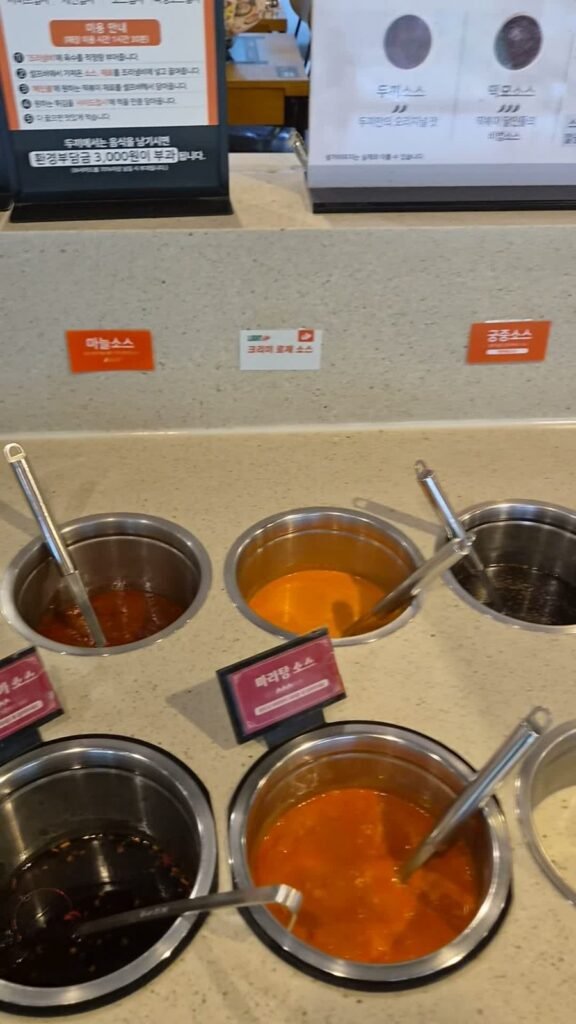
Then adjust. I made the standard mix and stirred in a little of the Busan-style sauce, which balanced the sweetness against the heat better than the base recipe on its own.
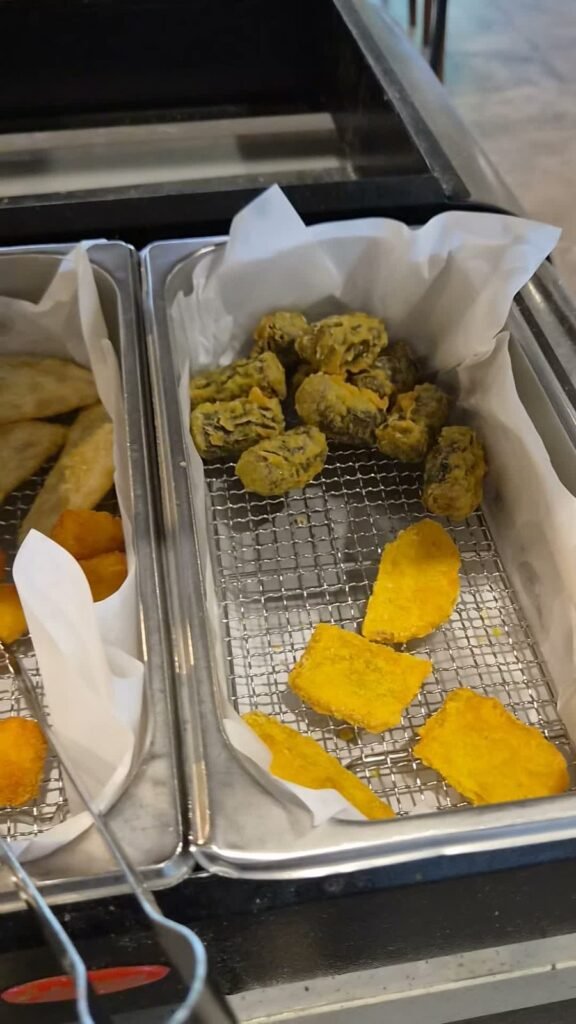
Grab the fried things before you start boiling. They are better dipped in the sauce once the pot has thickened, and you will not want to get up again once it is going.
It reduces. Trust it.
A full pot of raw ingredients looks absurd. Cabbage, mushrooms and tofu skin collapse to a fraction of their volume, so the mountain you were worried about turns into a normal amount of food.
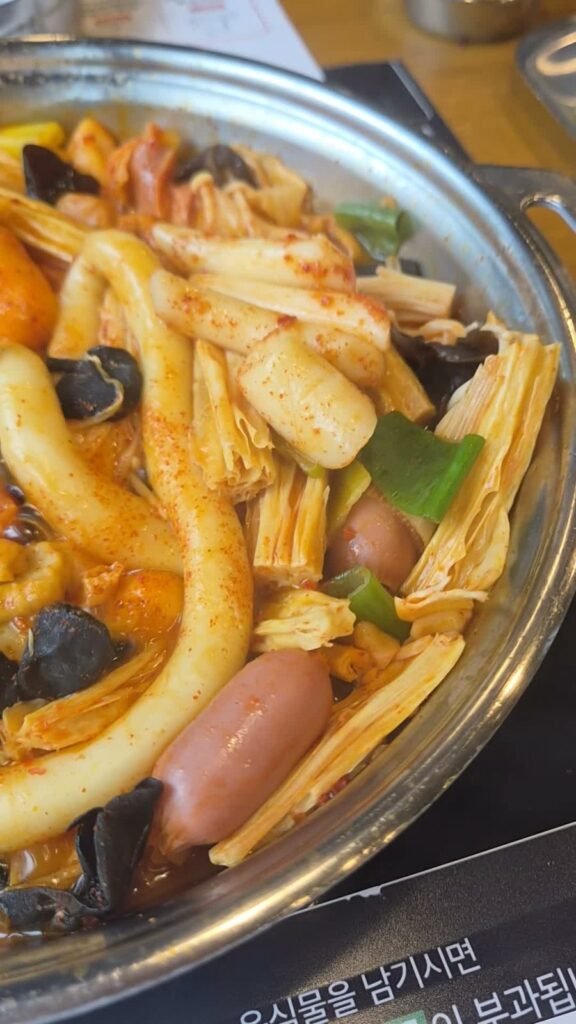
Rice cakes go chewy, and the tofu skin and fried bean curd soak up the sauce and release it when you bite — that texture is the reason to bother with a buffet rather than a plate of tteokbokki somewhere else.
Finish with the fried rice, and go easy on the kimchi
When the pot is nearly empty you turn the dial down to 1, add rice, and fry it in what is left. This is standard in Korea and it is the best part of the meal.
One warning learned the hard way: go light on the kimchi. Pile it in and the kimchi takes over, and the sauce you spent the whole meal building disappears underneath it. A small amount, and let the leftover sauce do the seasoning.
The ₩3,000 rule nobody warns you about
There is a green sticker on the table. Leave too much food and you are charged ₩3,000.
This is not a scam and it is not aimed at foreigners — it is how Korean all-you-can-eat places stop waste. But it does change how you should use the bars: go back four times with small amounts rather than once with a tower. There is no limit on trips.
What I cannot tell you
The buffet price. Dookki charges a flat rate per person and it differs by branch, and I did not write this one down. Check it on Naver Map before you go. What I can tell you is the ₩3,000 waste charge for leaving a lot of food.
The honest verdict
Go if: you have at least five hours between flights and enough time left after arrival formalities for a slow meal and the return journey. The self-service format can make ordering easier, but it does not remove the time needed to cook and eat.
Do not go if: your connection is under five hours or the remaining time does not cover the whole outing. Stay inside in either case. If you have sufficient time but prefer a quicker meal, soup near Unseo station is an alternative; if you prefer help with grilling, read the Korean barbecue guide. Both still require their own time check.
It was full of teenagers when I went, which tells you what it is: cheap, loud, and not remotely a tourist experience. That is a recommendation.
FAQ
Do I need to speak Korean at a tteokbokki buffet?
No. There is no menu and no ordering. You serve yourself from open counters and there is a Dookki manual on the table.
What if I cannot eat spicy food?
You control the sauce entirely, so you can make the pot as mild as you want.
Is there anything a vegetarian can eat?
You choose every ingredient, so a pot of rice cakes, cabbage, mushrooms, tofu skin and noodles is straightforward. I did not check whether the stock or individual sauces contain fish or meat, so if that matters to you, ask. The full set of options for eating without meat around the airport, and the phrases that get you a straight answer, sits in its own piece.
What is the 3,000 won charge at Korean buffets?
It is a waste charge. At Dookki, leaving a lot of food or side items can trigger it. Take small amounts and go back as often as you like — there is no limit on trips.
How far is Dookki Yeongjong from Incheon Airport?
It is in the Sky City district of Yeongjong, roughly twenty minutes from the terminal. Take the AREX all-stop train to Unseo (7–8 minutes from Terminal 1, ₩1,200) and continue from there.
Prices and opening hours were accurate when this was written. Check on Naver Map on the day — it is the map app Koreans actually use and it has an English mode. Download it while you are still on the airport wifi; it provides live bus departure information in Korea, and buses on Yeongjong run infrequently enough that the wait can be longer than the ride.