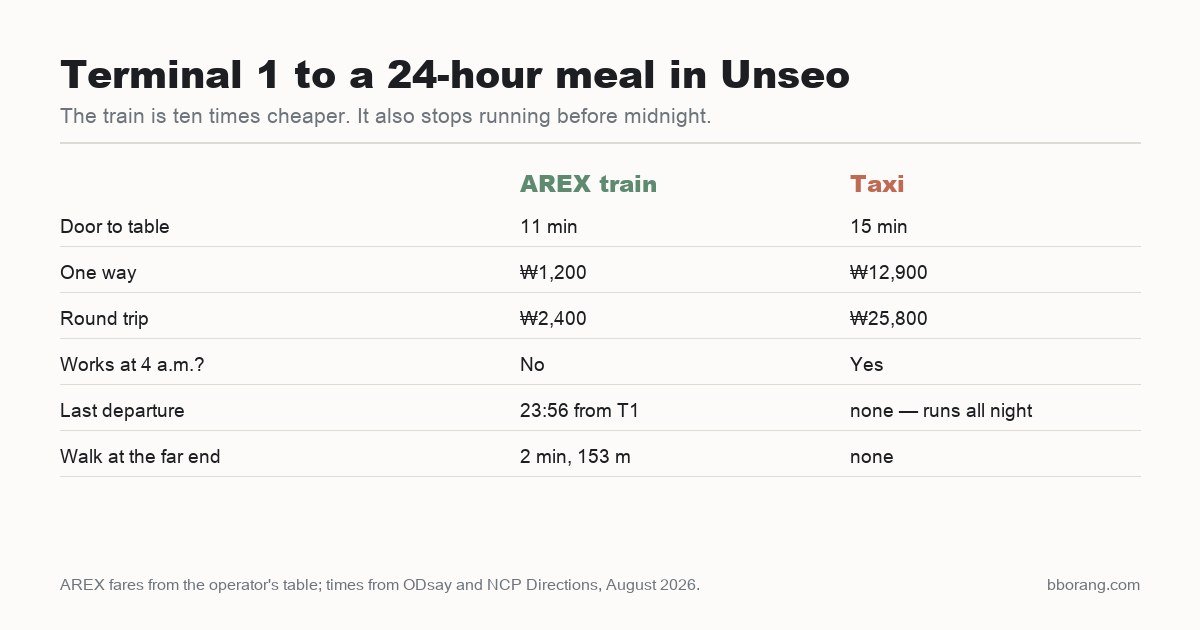
The short answer: yes, there is one. Bobae Banjeom (보배반점) is a Chinese-Korean restaurant in Unseo, open 24 hours a day, every day of the year, and it sits a two-minute walk from Unseo Station — two stops down the line from Terminal 1. In daylight that trip takes 11 minutes and costs ₩1,200. At four in the morning it does not, because the airport train is not running, and you are looking at a ₩12,900 taxi each way instead.
The train timetable is the whole argument here, so it is built into the layover calculator — enter a pre-dawn landing and it drops everything the train cannot reach.
That single fact reshapes the whole question. Most layover guides for Incheon quietly assume a daytime arrival, and plenty of long-haul flights from North America and Europe land at three, four or five in the morning instead — when the train has not started and the arrivals hall is the only thing awake. This is what your options actually look like then.
Is anything open near Incheon Airport in the middle of the night?
Not much, and Bobae Banjeom (보배반점) is the one place on Yeongjong I can point to with confidence: the restaurant states it is open 24 hours a day, year-round, with no closing day. Yeongjong is a commuter and resort area rather than a nightlife district, so do not assume the beach cafés and barbecue restaurants elsewhere on the island keep the same hours.
There are two branches on the island and they matter for different reasons. The Unseo branch (운서점) is the one worth knowing about for a layover, because it is walkable from a train station. The Yeongjongdo branch (영종도점) is out in Hanuldosi, a taxi ride away. I have eaten at both — same restaurant, same menu, same prices — but the photos below and the room I describe are from Hanuldosi.
| Unseo branch 운서점 | Yeongjongdo branch 영종도점 | |
|---|---|---|
| Address to paste | 인천 영종구 영종대로162번길 20 110~111호 | 인천 영종구 하늘달빛로 90-21 103호 |
| From Unseo Station | 2-minute walk, 153 m | not walkable |
| Taxi from Terminal 1 | 15 min, 12.4 km, ₩12,900 | 20 min, 13.5 km, ₩13,700 |
| Taxi from Terminal 2 | 14 min, 11.2 km, ₩12,000 | 21 min, 19.1 km, ₩17,700 |
| Open | 24 hours, year-round | 24 hours, year-round |
| Google Maps | Bobae Banjeom Unseo branch pin | Bobae Banjeom Yeongjongdo branch pin |
Copy the Korean address straight into Naver Map or hand it to the driver. Romanised names do not return the right result in Korean map apps, and a driver at 4 a.m. should not have to decode them.
How do you get from Terminal 1 to Unseo at 4 a.m.?
By taxi, because there is no alternative at that hour. The all-stop AREX train is the cheap option by a factor of ten, but it keeps normal hours.
The last all-stop train out of Terminal 1 towards Unseo leaves at 23:56. The first one of the next day leaves just after five in the morning — published timetables disagree by a few minutes on exactly when, so check the day’s schedule rather than trusting a number in a blog post, this one included. Coming back the other way, the last train from Unseo to the airport runs at 00:32. Between roughly half past midnight and a quarter past five, the platform is empty.
So the decision is simple. Land after about 5:30 a.m. and the train is a ₩1,200 non-decision. Land at 4 a.m. and you are choosing whether a real meal is worth roughly ₩26,000 of taxi fares round trip. Terminal 2 passengers should read how Terminal 1 and Terminal 2 differ for getting off the airport first, because the taxi from Terminal 2 to Unseo is actually slightly cheaper, while the train from Terminal 2 costs more.
Before you commit to any of this, be sure you are allowed to leave at all — the rules on whether you can legally exit Incheon Airport during a layover depend on your passport and your ticket. Immigration is also the part of the trip that ruins schedules: queues at the foreign passport desks were measured at over an hour and twenty minutes during the 2026 summer peak. I do not have a measured figure for pre-dawn arrivals specifically, so budget generously rather than assuming an empty hall.
What should you order at Bobae Banjeom?
The tangsuyuk. I go to Bobae Banjeom for the sweet and sour pork more than for the noodles, and it is the thing the kitchen clearly cares about. The batter is thin and it comes out genuinely crisp, and the sauce arrives in its own bowl instead of poured over the plate, so nothing goes soft while you sit there. It also survives being ignored — I picked at it the whole time I was mixing the noodles and it never went limp.
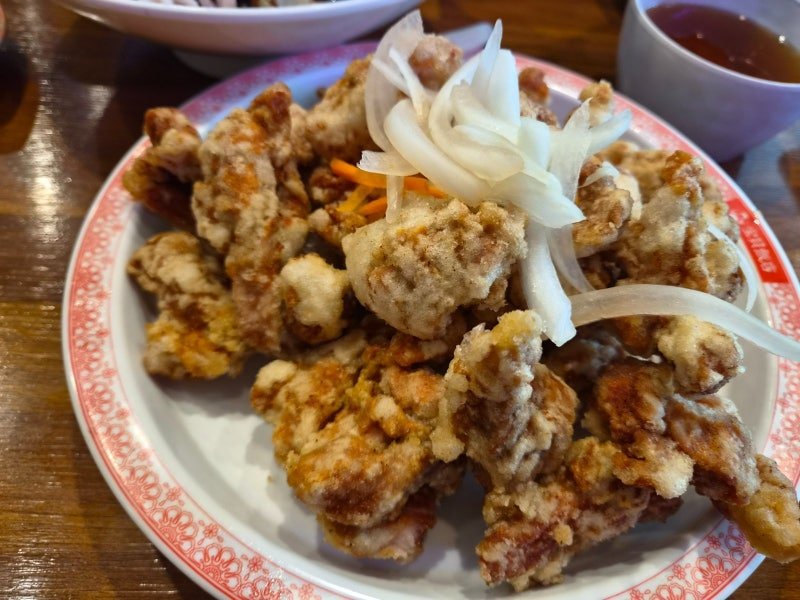
That matters more than it sounds if you are travelling alone, because tangsuyuk is normally a sharing dish and ordering it solo means committing to a platter for two. Bobae Banjeom lists a one-person size at ₩15,000. Solo diners are unremarkable in Korea generally, but a single portion of fried pork is a genuinely useful thing to find on a menu.
The ganjjajang was the other dish I ordered. A whole fried egg goes on top, the prawns and squid are left in big pieces rather than diced into the sauce, and the noodles are thick enough to chew. The sauce is not sweet — there is a bit of char to it, the old-fashioned style. Break the yolk into it before you mix, and mix it quickly, because the noodles will start to swell.
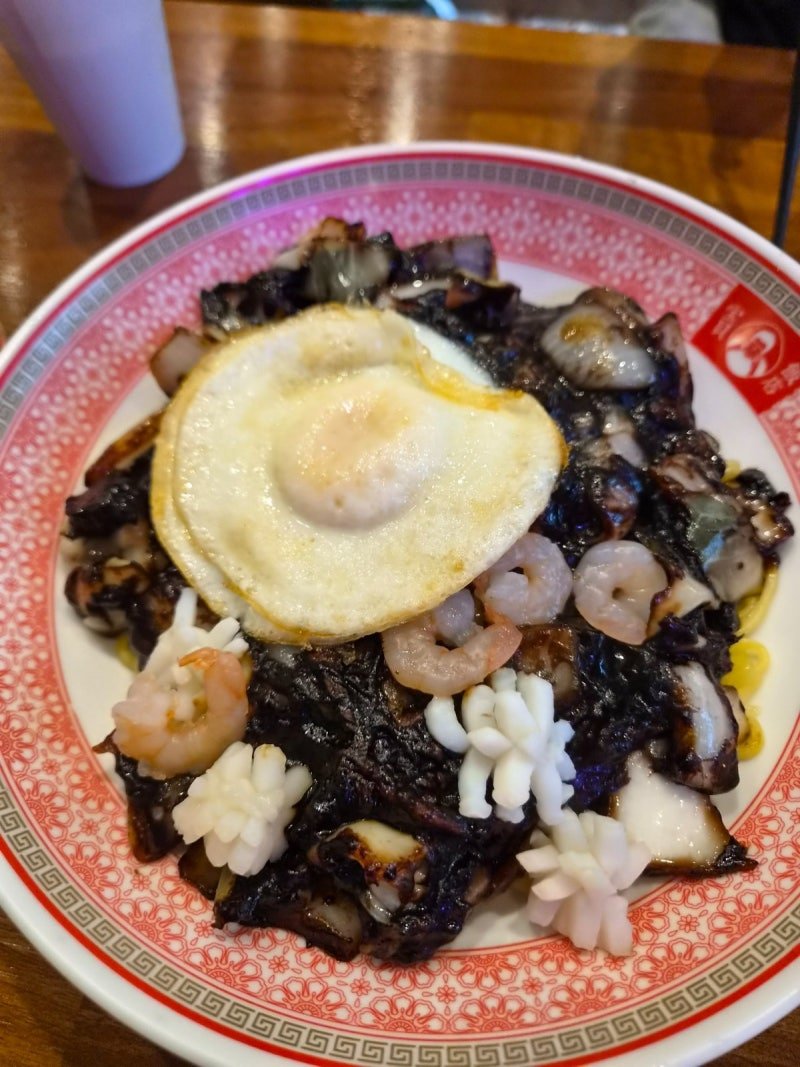
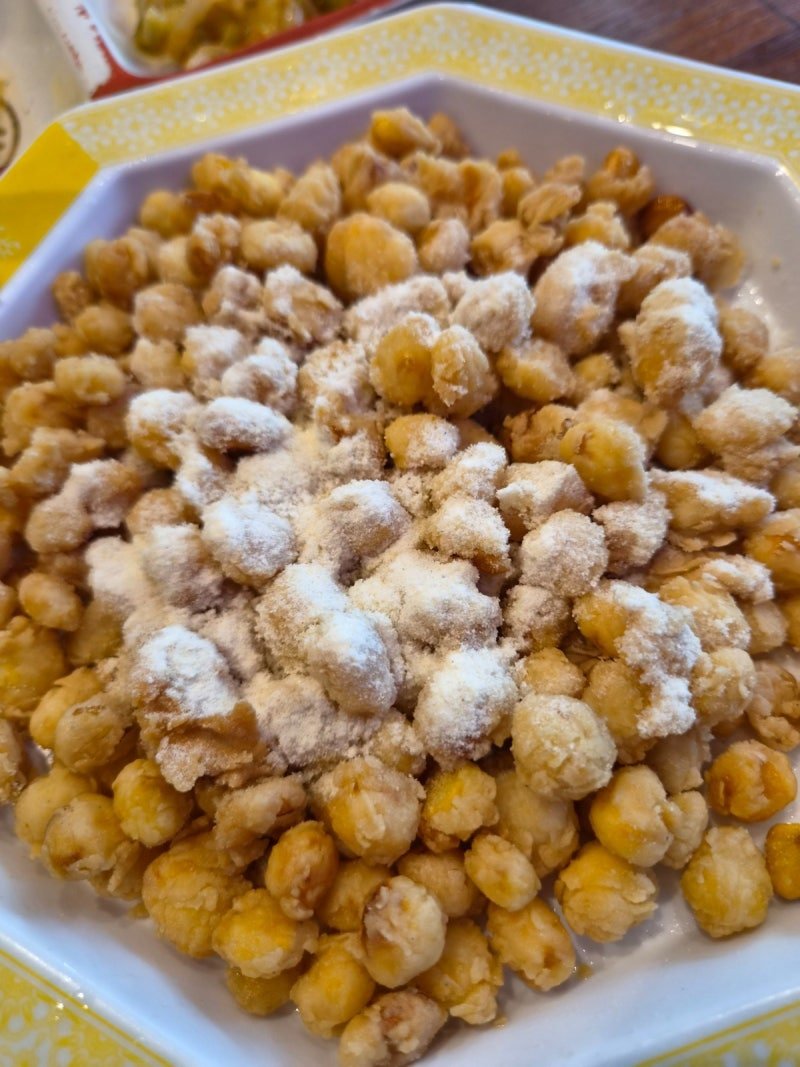
The third thing on the table was fried corn with consommé seasoning, which I ordered out of curiosity and would order again. Whole corn kernels are battered individually, fried, then dusted with a savoury powder, so each one pops sweet and the coating is salty. It is a beer snack that happens to be on a Chinese restaurant menu.
How much does it cost?
| Dish | Korean | Price |
|---|---|---|
| House jjajangmyeon | 보배짜장면 | ₩9,000 (₩10,000 large) |
| House jjamppong, the spicy seafood noodle soup | 보배짬뽕 | ₩11,000 (₩12,000 large) |
| Tangsuyuk, mini — one person | 탕수육 미니 | ₩15,000 |
| Tangsuyuk, small — two people | 탕수육 소 | ₩20,000 |
| Tangsuyuk, medium — three people | 탕수육 중 | ₩26,000 |
| Tangsuyuk, large — four people | 탕수육 대 | ₩32,000 |
A solo meal of noodles plus the one-person tangsuyuk lands around ₩24,000. Add the round-trip taxi at 4 a.m. and you are near ₩50,000 for the outing — which is the number to weigh against an airport meal, not the food price on its own.
A few things are simply true of eating out in Korea and worth stating plainly, because guides aimed at visitors often leave them out. Cards are taken everywhere, so you do not need to hunt for an ATM. Water, cups and cutlery are usually self-serve from a station by the wall. Side dishes and refills are free. There is no tipping and no service charge added to the bill.
What is it actually like inside?
Old-school, deliberately. Green walls, red lanterns hanging from the ceiling, the look of a neighbourhood Chinese restaurant from decades ago rather than anything renovated recently. The tables are spread out with real room between them, and I did not feel conspicuous sitting alone.
There was no queue when I went, which is the normal state of the place. The catch is what happens after you order.
What could go wrong?
The food comes out one dish at a time, with gaps. That is what happened on my Hanuldosi visit: there was no wait for a table, but there was a wait for the meal, and the dishes arrived staggered rather than together, so the full spread took a while to land in front of me. My own verdict was that the tangsuyuk and the fried corn were worth that wait. On a schedule, with a flight to catch, it is still the part that will make you anxious, so order everything at once and expect to sit.
The other risk is on your side of the trip, not theirs. A taxi is a single point of failure at 4 a.m. in a way a train is not, and if you have a suitcase with you the whole calculation gets worse — it is usually better to put the bag down first, and the luggage storage options at Incheon Airport and what each one costs covers which counters stay open around the clock.
Opening hours change without warning anywhere. Pull up 보배반점 in Naver Map on the day and check before you commit to a taxi — Naver Map, not Google Maps, is the app that has accurate Korean business hours.
Is it worth going?
If you land before dawn with six hours or more, and the alternative is another airport sandwich, yes. You get a hot meal cooked to order in an ordinary neighbourhood restaurant at an hour when that should not be possible, and you get back with time to spare.
If you have under five hours, no. Immigration alone can eat an hour and a half, the food is not fast, and a taxi in each direction gives you nothing to fall back on. If you land after the first train and you would rather spend ₩1,200 than ₩26,000, the Korean soup restaurant a ten-minute walk from Unseo Station is the better daytime version of this same trip. Bobae Banjeom earns its place for one specific reason: it is open when nothing else is. For the rest of the night around it — the train times, the taxi surcharge and where a bag goes at 2am — see the guide to an overnight layover at Incheon Airport.
Frequently asked questions
Is Bobae Banjeom really open 24 hours?
Yes. The restaurant states it is open 24 hours a day, year-round, with no regular closing day, and both the Unseo and Yeongjongdo branches operate the same way. Hours can still change, so confirm in Naver Map on the day you plan to go.
Can I get to Unseo from Incheon Airport by train at 4 a.m.?
No. The last all-stop train from Terminal 1 towards Unseo leaves at 23:56, and service resumes just after 5 a.m. Between those times a taxi is the only way off the airport, at roughly ₩12,900 from Terminal 1 and ₩12,000 from Terminal 2 to the Unseo branch.
Is it awkward to eat there alone?
No. Eating alone is unremarkable in Korea, the tables are well spaced, and the menu has a one-person tangsuyuk at ₩15,000, so you are not forced into a sharing platter. Noodle dishes are single portions by default.
How much time should I allow for the whole trip from Terminal 1?
Allow at least six hours of layover. Before the first train the taxi is 15 minutes each way; after it there is no taxi at all, just 11 minutes and ₩1,200 on the train. Immigration on arrival has been measured at over 80 minutes at peak, the food at the Hanuldosi branch arrived dish by dish rather than all at once, and you still have to clear security and immigration again on the way back to your gate.
Which branch should I go to?
The Unseo branch (운서점), at 인천 영종구 영종대로162번길 20 110~111호. It is 153 metres from Unseo Station, so during the day you can reach it on a ₩1,200 train ticket and a two-minute walk. The Yeongjongdo branch in Hanuldosi requires a taxi from anywhere.