The short answer: Bangatgan (방앗간 한식뷔페) is a ₩9,900 all-you-can-eat Korean side-dish buffet, 18 minutes by taxi from Incheon Airport Terminal 1. One price covers rice, soup, the day’s hot main and a whole counter of banchan, for as long as you sit there. The thing that makes it worth the trip is that the line is rewritten every day — the two menu boards I photographed here, eleven weeks apart, have no dish in common. Prices seen in August 2026.
Stay inside the airport on a connection under five hours. With more time, decide after arrival formalities: the remaining time must cover this meal, the return journey, any baggage errands and your airline’s deadlines.
What is a banchan buffet, and why go to one on a layover?
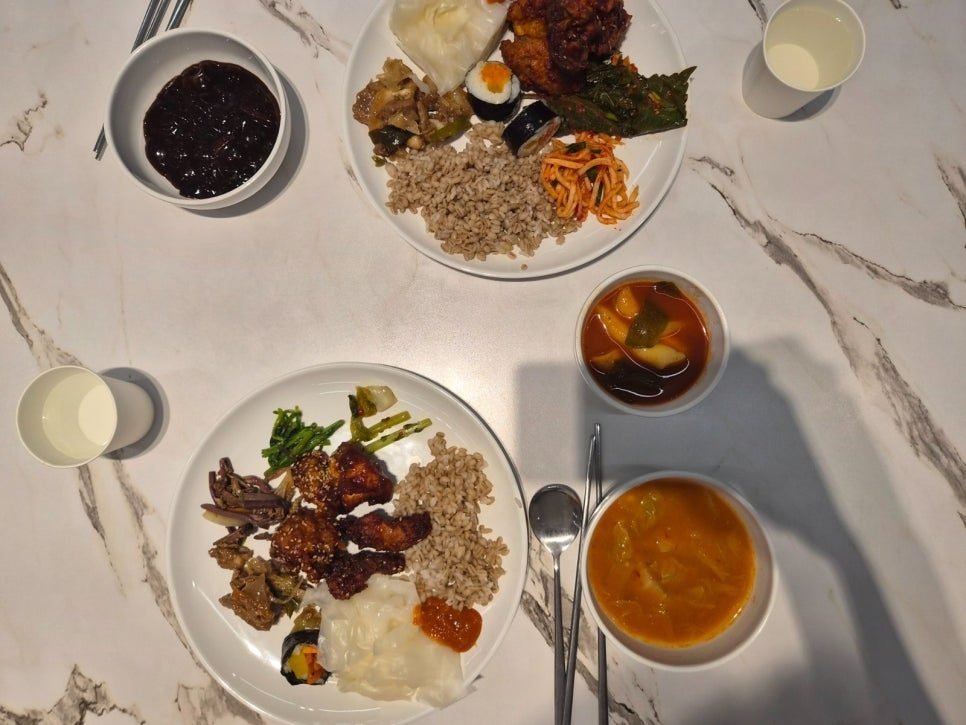
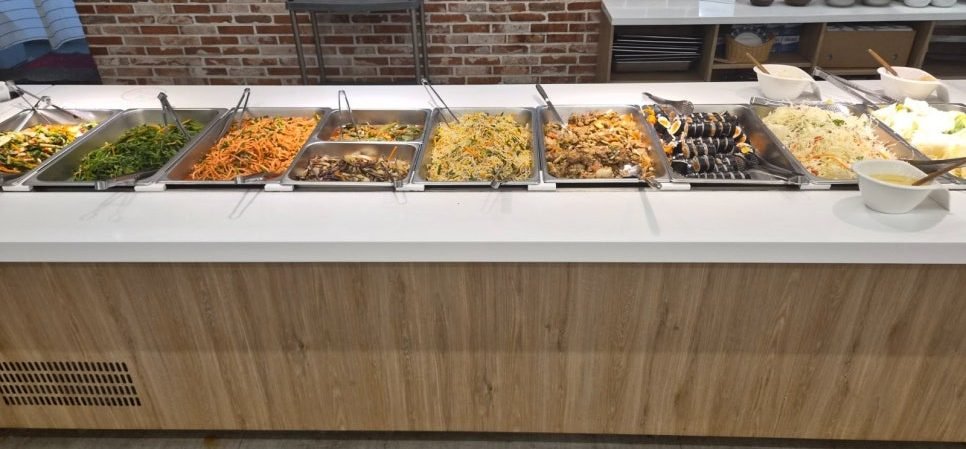
A hansik buffet is not a hotel breakfast spread and not a carvery. It is the Korean home table, served at scale: a rice cooker, a pot of soup, one or two hot main dishes, and a long counter of banchan — the small vegetable, egg and pickled dishes that come free alongside rice in any Korean restaurant. You take a plate and build the meal yourself.
On a layover that shape solves two problems at once. There is nothing to order, so nothing to get wrong and no waiting on a kitchen — you eat as soon as you have filled a plate. And you can see every dish before it goes on your plate, which is worth more than any English menu. If you have ever pointed at a Korean menu and hoped, this is the version of that where you cannot lose.
How long does the whole trip take from Terminal 1?
| Step | Good day | Bad day |
|---|---|---|
| Deplane and walk to immigration | 10 min | 25 min |
| Immigration queue | 25 min | 90 min |
| Bags and storage | 0 min | 55 min |
| Taxi to Sky City | 18 min | 30 min |
| Serve yourself, eat, pay | 35 min | 55 min |
| Taxi back to the terminal | 18 min | 30 min |
| Security, immigration, gate | 35 min | 90 min |
| Total | ~2 hr 20 | ~6 hr 15 |
The immigration queue is the row that decides the table, and it is the one you cannot control. Everything else is fairly predictable. The full time math for leaving Incheon Airport on a layover goes through why that queue swings so hard.
If you are carrying bags, leave them at the terminal rather than dragging them up to a second-floor dining room — luggage storage at Incheon Airport covers where the counters are and what they cost.
How do you get to Bangatgan from Incheon Airport?
| From | By taxi | Distance | Fare |
|---|---|---|---|
| Terminal 1 | 18 min | 14.1 km | ₩14,200 |
| Terminal 2 | 20 min | 19.7 km | ₩18,400 |
| Unseo station (운서역) | 13 min | 10.6 km | ₩11,600 |
| Yeongjong station (영종역) | 11 min | 5.0 km | ₩7,700 |
Show the driver this address: 인천 영종구 하늘달빛로 90-27 210호 (중산동, 동오프라자). The building is the one with the JAJU homeware store; the buffet is on the second floor. Bangatgan on Google Maps will put a pin in the right place, which is enough for a driver. For opening hours on the day you go, Naver Map is the one Koreans actually use — search 방앗간 한식뷔페. Korean taxis take cards, so there is no need to find an ATM first.
There is a bus if you would rather not spend ₩14,200. Route 202 leaves from stop 13B on the first floor of Terminal 1, runs 39 minutes to 동보노빌리티, and costs ₩1,500 with no transfer — about 45 minutes door to door with the walk at each end. From Unseo station, bus 221 does the same job in about 35 minutes for ₩1,500. Both are fine if you have the time; on a tight layover the taxi is buying you back half an hour.
What is actually on the buffet line?
Whatever they cooked that morning. There is a chalkboard standing at the door with the date written across the top and the day’s dishes under it, and that board is the whole menu. This is the part I can show rather than claim, because I photographed it on two different visits.
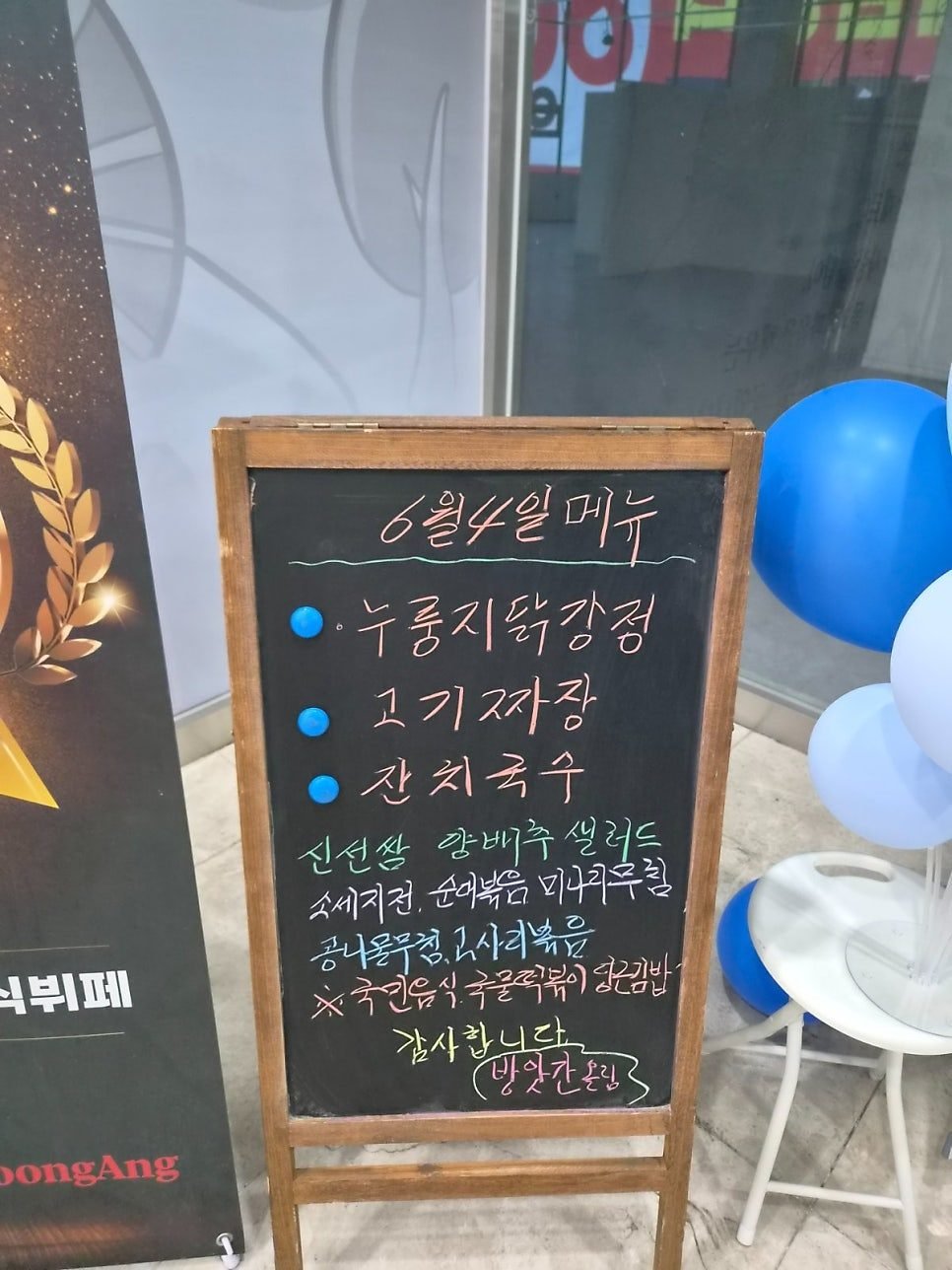
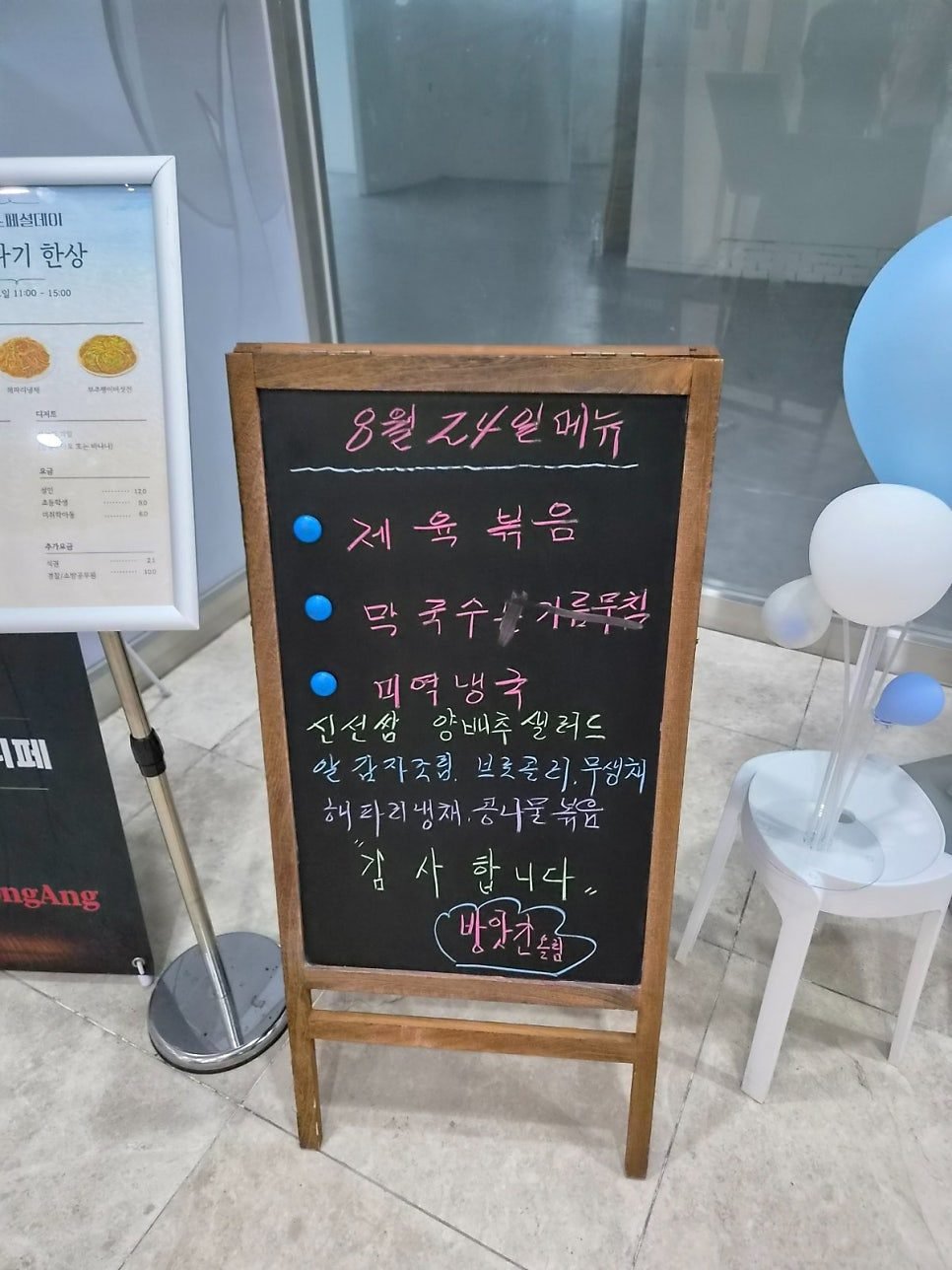
On 4 June the mains were chicken gangjeong fried with scorched rice, a meat jjajang, and janchi guksu. On 24 August they were jeyuk bokkeum — pork stir-fried with onion and spring onion, soy-based rather than fiercely hot — with makguksu and a chilled seaweed soup, and the supporting line read ssam leaves, cabbage salad, braised baby potatoes, broccoli, musaengchae, jellyfish salad and stir-fried bean sprouts. Two boards, eleven weeks apart, with nothing in common. On a third visit in between, on 11 August, the tray that dominated the counter was duruchigi — pork braised red with onion and spring onion, in two big trays.
That is the honest reason to come here rather than to the ₩10,000 Korean buffet in Unnam-dong, which is closer to the airport and opens at 6am but runs one fixed main per weekday. If you want to know what you are getting before you leave the terminal, go there. If you want the version where you find out at the door, come here.
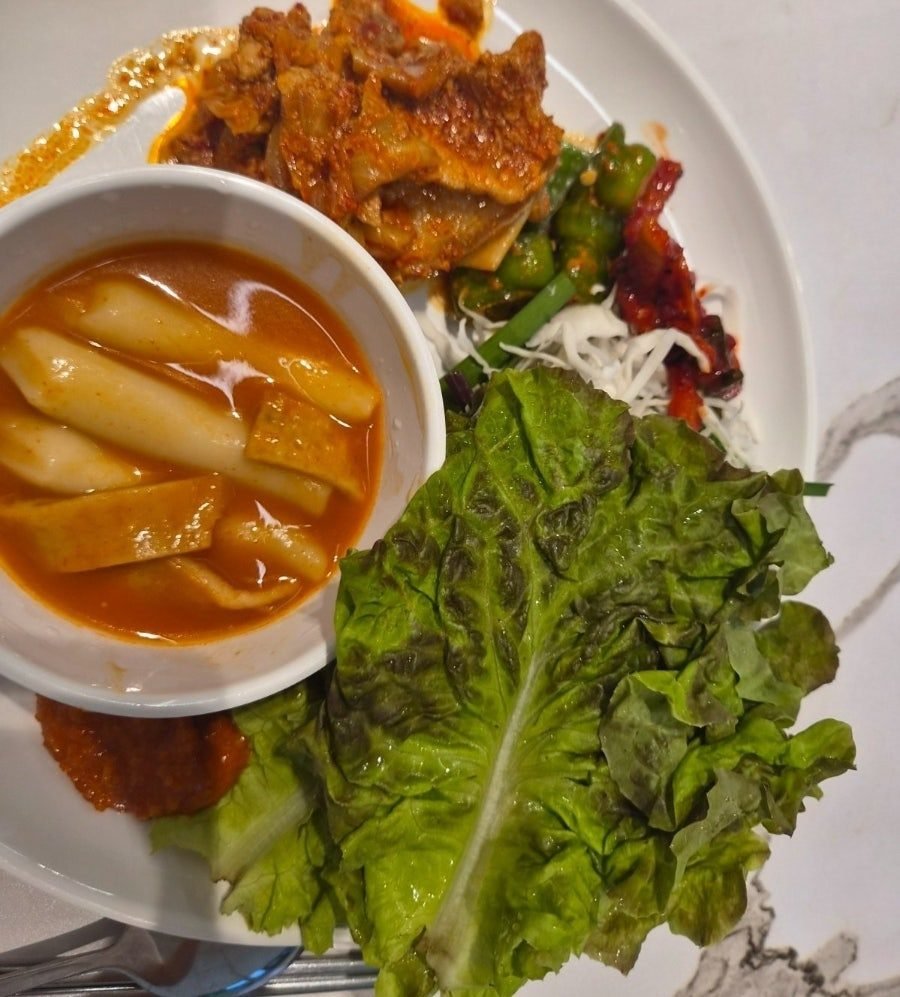
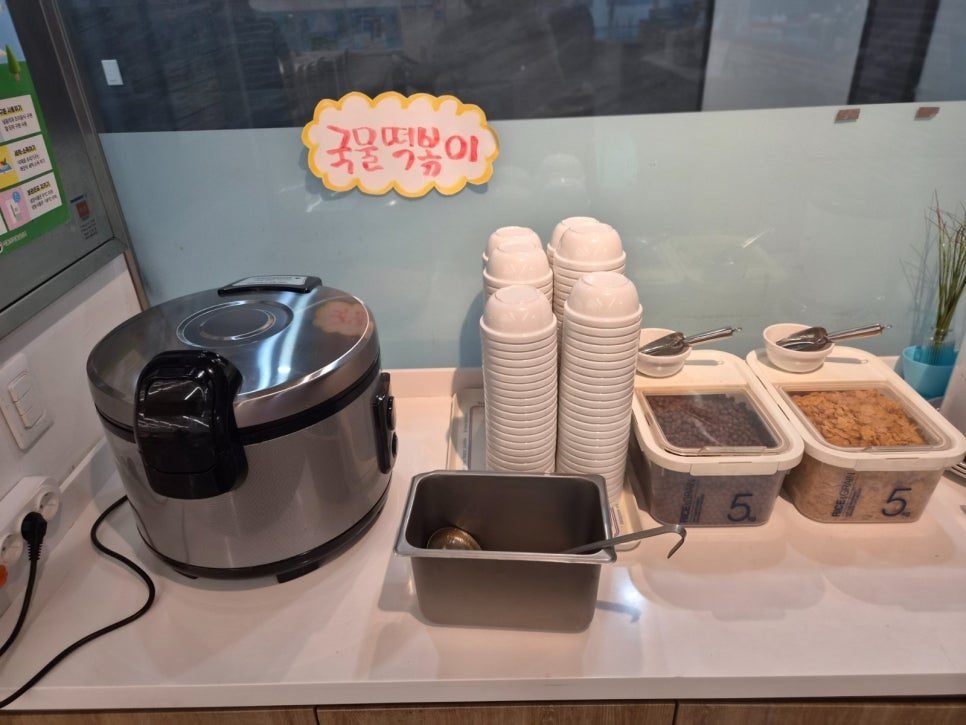
Two things do not change. One is a warmer of gukmul tteokbokki — rice cakes in a thin, sweet-leaning broth with wide slices of fish cake — sitting on the self-serve counter with bowls and a ladle stacked beside it. It is mild to the point of being under-seasoned, which is a complaint if you came for tteokbokki and a relief if you are feeding a child. The other is a pair of tubs of breakfast cereal next to it. If you have seen the tteokbokki buffet down the road, this is the opposite end of that idea: there, tteokbokki is the entire meal and you cook it; here it is a side you ladle out on the way past.
One detail told me more about the place than the food did. In August a tray of tofu ran dry, and rather than leave the slot empty the kitchen refilled it with spicy braised pork trotter. That is the trade you are making at ₩9,900: nothing is guaranteed to still be there, but the gap gets filled with something else. The corollary is that the popular trays go first, so if there is a dish on the board you came for, arrive early in the service rather than late.
What does ₩9,900 include, and what costs more?
| What | Price | Notes |
|---|---|---|
| Weekday buffet, adult | ₩9,900 | Rice, soup, the day’s mains and the whole banchan line |
| Breakfast rate | ₩8,000 | Listed on the menu; the posted hours I saw begin at 11:00 |
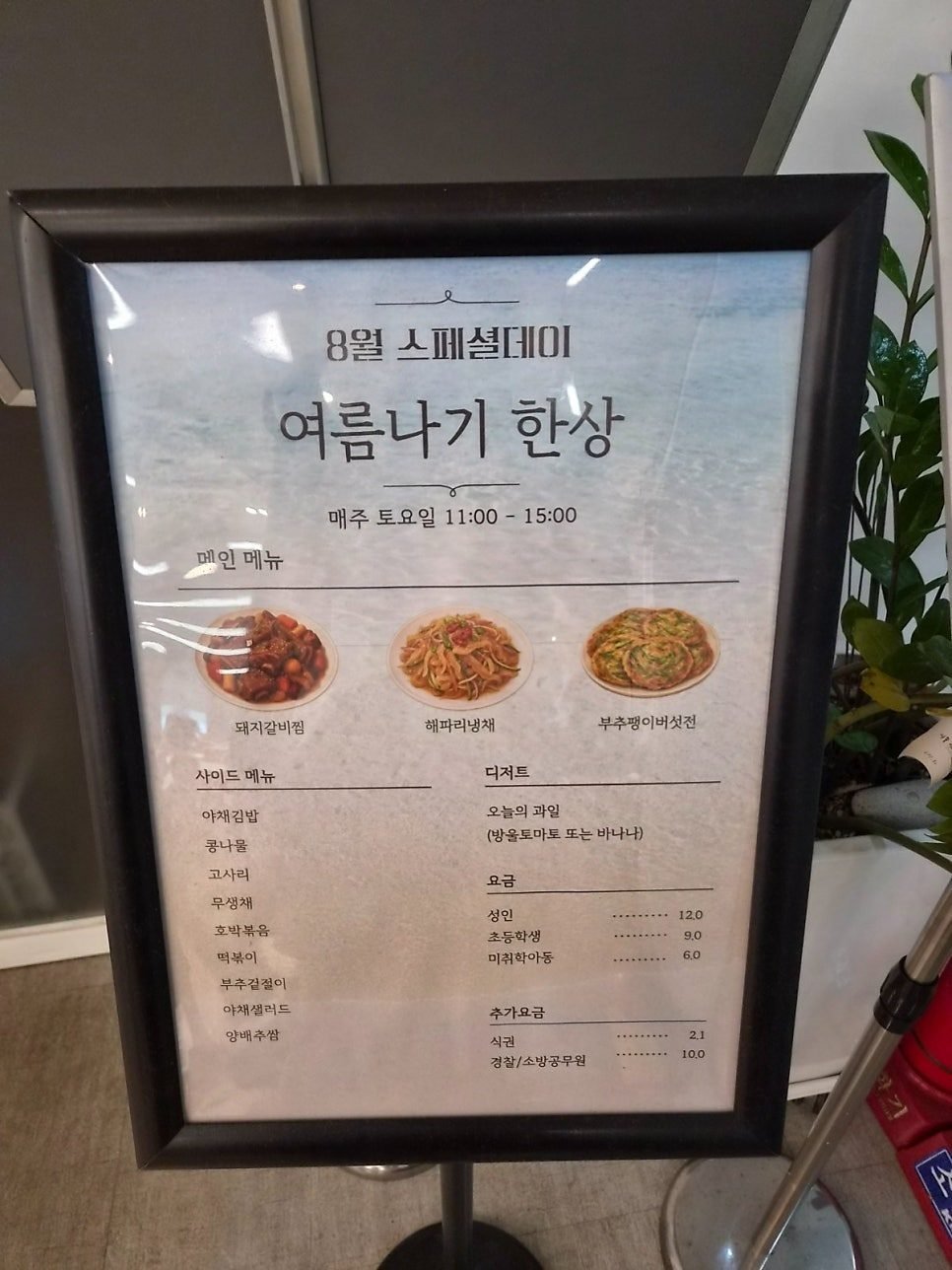
| Saturday set (한상), adult | ₩12,000 | Saturdays 11:00–15:00 only, different menu |
| Saturday set, primary-school child | ₩9,000 | |
| Saturday set, pre-school child | ₩6,000 | |
| Lunchbox, delivered | ₩8,000 / ₩6,000 | Dosirak of the day / healthy bibimbap |
| Lunchbox, collected | ₩7,000 / ₩5,000 | ₩1,000 off for picking it up yourself |
The Saturday set is worth knowing about because it is not the buffet with a different name. It is a plated spread with its own printed menu, served 11:00 to 15:00, and it too gets rewritten. In June it was a chive-and-bossam table: boiled pork belly with chives, a chive pancake and a chilled cucumber-and-seaweed soup. By August the same slot had become braised pork ribs, jellyfish salad and a chive-and-enoki pancake. Same price, same hours, completely different food.
When is it open, and when is the break time?
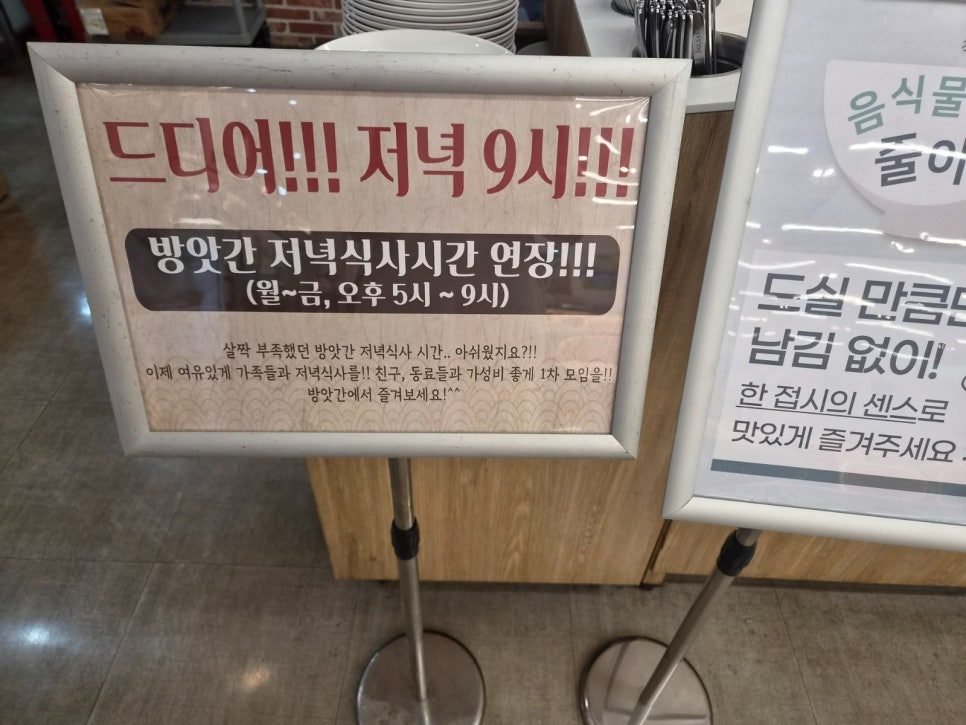
Lunch runs 11:00 to 14:30 on weekdays. Then the doors shut for a break from 14:30 to 17:00, and dinner runs 17:00 to 21:00. The break is the single most common way visitors get caught out in Korea — arriving at 15:30 to a dark dining room is not a closure, it is the middle of the day.
The 21:00 close is recent. There is a notice up inside announcing it, which is how I know it changed rather than guessing: dinner used to end earlier, and the extension is Monday to Friday.
Because the hours have moved once already, check them on the day rather than trusting this page. And if you land at dawn, this is not your restaurant — the hours posted on the door start at 11:00. The soup house that opens at 6am is the one for a pre-dawn arrival.
What should you know before walking in?
Water, spoons, chopsticks and bowls are self-serve, on a counter by the brick wall. Nobody will bring them to you and nobody is ignoring you — this is normal in Korean canteens, and so is getting up to refill your own water. There is no tipping in Korea and no service charge, so the price on the board is what you hand over.
Eating alone here is completely unremarkable. On my last visit the room held solo diners, people paying with meal vouchers, and a family getting a child fed. A buffet is the easiest version of solo dining in Korea anyway: no set menu built for two, no minimum order.
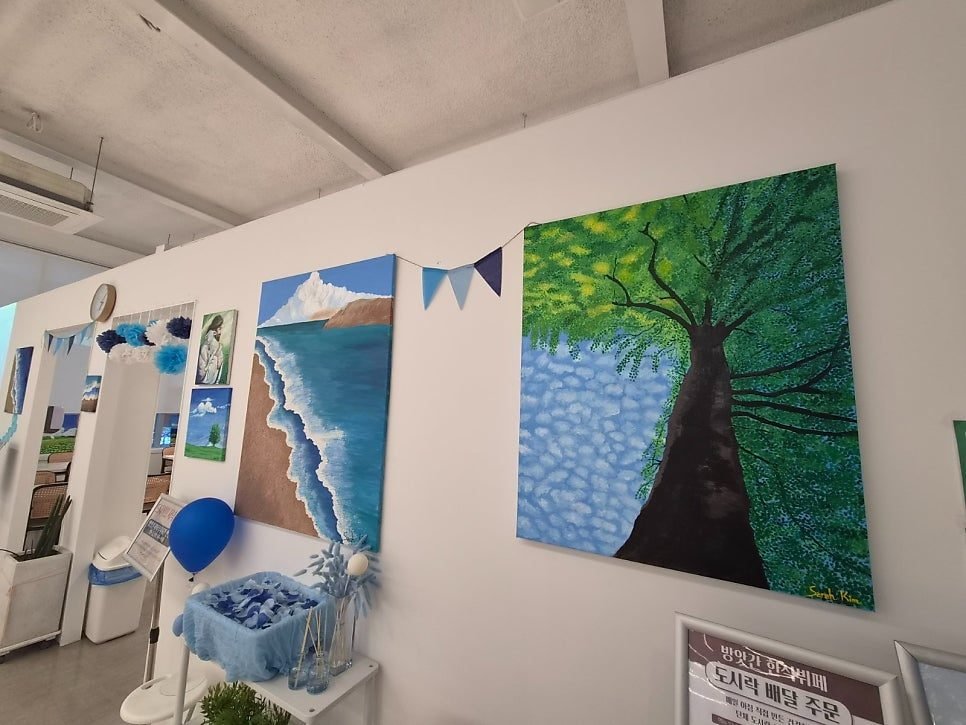
The dining room is brighter than it needs to be for the price. There are large paintings on the wall — a tree and a shoreline, signed by the artist — and it reads more like a small gallery than a canteen. Of the several Korean buffets I have eaten at on this island, it is the cleanest.
If you drive, the building car park gives an hour free, but you have to register your plate yourself on the tablet inside the restaurant. The posted notice is explicit that skipping that step means you get charged on the way out.
Who should skip it?
Anyone who does not eat chilli will find the line narrower than the tray count suggests. A lot of the banchan is dressed red — pickled chilli, musaengchae, kimchi, the braised pork — and on one visit that left me building plates mostly from the namul and the pork. There is always enough, but you are eating around a good part of the counter rather than through it.
Skip it if you want a signature dish. Nobody comes to a hansik buffet for one perfect thing, and you should not either. The musaengchae is seasoned to be eaten with rice and is genuinely too salty on its own; the tteokbokki is under-seasoned; the pleasure is in the assembly, not in any single tray.
Strict vegetarians should be careful rather than reassured. There are more vegetable dishes here than at most places on the island, but Korean side dishes routinely carry fish sauce or salted shrimp in the seasoning, and there is no ingredient labelling on a buffet line. The full set of options for eating without meat around the airport, and the phrases that get you a straight answer, sits in its own piece.
Skip it on a connection under five hours, and whenever the remaining time is too short after arrival formalities. The longer table scenario is about six hours fifteen, before separately allowing for omitted waits and the boarding cutoff. A quick buffet meal does not make the airport procedures predictable.
If the price is what brought you here, there is a cheaper one on the same side of the island: Puzzle Food, where the adult rate drops to ₩7,000 between 4pm and 7pm. Bangatgan wins on the side-dish counter; Puzzle Food wins on an afternoon arrival.
Frequently asked questions
How much does a Korean banchan buffet near Incheon Airport cost?
Bangatgan charges ₩9,900 per adult for the weekday buffet, which covers rice, soup, the day’s main dishes and the full side-dish counter with unlimited refills. The Saturday set menu is ₩12,000 for adults, ₩9,000 for primary-school children and ₩6,000 for pre-schoolers. Prices seen in August 2026.
Is there an English menu at Bangatgan?
No, and you do not need one. The only menu is a handwritten Korean chalkboard by the door listing the day’s main dishes, and everything else is visible in the trays. You pay at the counter, take a plate and serve yourself.
How far is Bangatgan from Incheon Airport Terminal 1?
Bangatgan is 14.1 km from Terminal 1, about 18 minutes by taxi and roughly ₩14,200, checked on 2 September 2026. From Terminal 2 it is 19.7 km, about 20 minutes and ₩18,400. Bus 202 from stop 13B at Terminal 1 takes about 45 minutes door to door for ₩1,500.
What time does Bangatgan close for break time?
Lunch ends at 14:30 and the restaurant is shut until 17:00, then serves dinner until 21:00 on weekdays. Arriving between 14:30 and 17:00 means a closed door. The hours have been extended at least once in 2026, so check 방앗간 한식뷔페 in Naver Map on the day you go.
Can you eat alone at a Korean buffet?
Yes, and it is one of the easiest solo meals in Korea. There is no set menu built for two people and no minimum order, and at Bangatgan solo diners are a normal part of the room on a weekday.
I paid for these meals myself across three visits in June and August 2026. Prices, hours and menus as posted on those dates — the whole point of this restaurant is that the menu changes, so treat the dishes named above as examples rather than as what will be waiting for you.