The short answer: a five-hour layover may leave time for one nearby meal, but decide only after arrival formalities. I recommend staying inside on connections under five hours. Six hours also needs a time check; neither a faster arrival nor a longer scheduled connection guarantees the return margin.
I live on Yeongjong, the island the airport is built on, fifteen minutes from the terminals. This page does not add new times. It takes the same planning table as the four-hour guide and the six-hour meal plan and cuts it in a different place. If your own gap is not exactly five hours, the layover calculator will run your numbers instead.
Why is 5 hours different from 4 or 6?
Because of where the uncertainty sits. The table below is the T1–Unseo meal outing with bags checked through, split into the part you can measure and the part you cannot. Meal and airport times are allowances, not measured minimums.
| Step | Good day | Bad day |
|---|---|---|
| Deplane and walk to immigration | 10 min | 25 min |
| Immigration queue | 25 min | 90 min |
| Out of arrivals | 35 min | 1 hr 55 |
| Platform, train to Unseo, walk to the table | 25 min | 35 min |
| Sit down, eat, pay | 40 min | 60 min |
| Walk back, train to the terminal | 20 min | 30 min |
| Security, departure immigration, walk to the gate | 35 min | 90 min |
| Everything after arrivals | 2 hr 00 | 3 hr 35 |
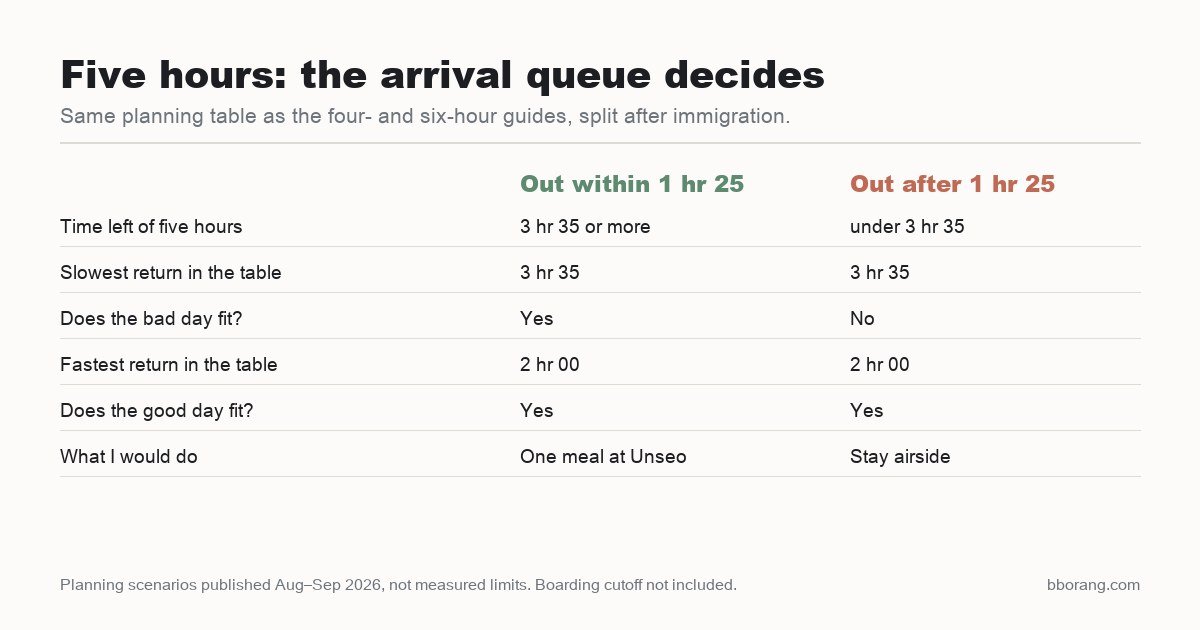
Five hours is 300 minutes. Subtracting the longer post-arrival scenario of 3 hours 35 leaves 1 hour 25 for arrivals, but that remainder is before your airline’s boarding cutoff and any omitted waits. It is an arithmetic remainder, not permission to leave the airport at that time.
Using that same longer post-arrival scenario leaves 25 minutes for arrivals in a four-hour connection and 2 hours 25 in a six-hour one, before extra waits and the boarding cutoff. A favourable short scenario can fit within four hours on paper, but I recommend staying inside because the margin is uncertain. With bags to collect, the six-hour guide also shows a longer scenario of 6 hours 25; six hours is not a guarantee either.
The check that settles a 5-hour layover
Arriving at the public arrivals hall gives you a real clock reading for one uncertain part of the day. The table’s 25- and 90-minute immigration figures are planning choices, not limits. Return transport and departure queues can still vary.
At the arrivals exit, start from your airline’s latest acceptable gate-arrival time, then subtract the return journey, departure procedures, the meal and extra room for waits. Leave only if the actual time remaining covers those steps. The airport time-budget guide explains the scenario assumptions.
Do not use 1 hour 25 after landing as a universal go/no-go cutoff. Your airline’s boarding deadline comes before departure, and a late inbound flight reduces the time available. Recalculate from the actual time after arrival formalities.
If you have to collect a bag, 5 hours is not the number
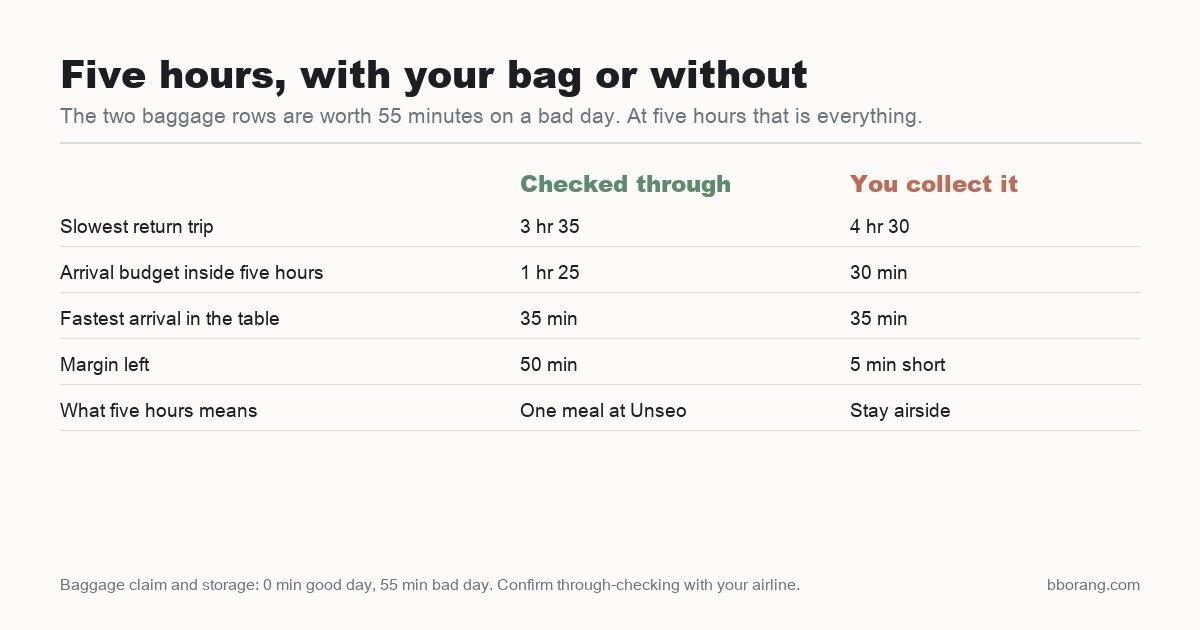
The table’s longer baggage-claim and storage allowance adds 55 minutes. Combined with the longer post-arrival block, that makes 4 hours 30 and leaves only 30 minutes for arrivals within five hours, before boarding and extra waits. That does not fit even the shorter arrival scenario in this example; I would skip the outing.
Do not treat six hours as a guaranteed minimum when you have bags to collect either. Ask your airline whether collection and re-checking are required, and confirm the relevant counter deadline. If you need storage, the terminal-by-terminal guide covers staffed counters. Allow time to retrieve the bag as well as to drop it off.
If you still have to check in, use the counter deadline
The table assumes you already have the onward boarding pass. If your airline requires a check-in or document check at a counter, add that stop and use its actual deadline. Counter closing and gate closing are different constraints; do not simply subtract one universal hour and call the rest usable outing time.
Where can you go with 5 hours at Incheon Airport?
Unseo (운서), and only Unseo. It is two stops down the AREX all-stop line, 7 to 8 minutes and ₩1,200 from Terminal 1, 14 to 15 minutes and ₩1,800 from Terminal 2 on an adult transport card. The express train to Seoul does not stop there. What makes it the answer at this length is not the minutes — it is that the far end is walkable and the return runs on rails, immune to the traffic that stretches a road trip on the way back.
Three places near the station carry a meal without a second decision: Unseook · 운서옥, a gomtang house with a photo menu about ten minutes on foot; Bobae Banjeom · 보배반점 운서점, two minutes from the station and open around the clock; and Dolsotbap Sundaeguk · 돌솥밥순대국 for sundaeguk with stone-pot rice. Those are meal choices, not a ranking of total outing times.
Sky City (하늘도시) and a taxi fare in both directions are a different decision, and one I would not add at five hours; the seven-hour comparison is where a road trip starts to be a fair trade. Seoul is not on the list at all — the T1 to Seoul Station ride alone is 55 minutes each way before any airport formalities.
Check which terminal your itinerary actually uses before you copy a route time, because T2 adds 6 minutes and ₩600 each way to Unseo; the terminal comparison covers the routes. You will need a way to pay for the train, which the T-money guide explains, and a data connection to check the journey, which the eSIM and Wi-Fi guide covers.
Does a night-time 5-hour layover change this?
It changes what you are relying on. If the trains are not running in one or both directions, the return depends on a road and a fare instead of a timetable, which is exactly the dependency the rail plan exists to avoid. Bobae’s overnight opening does not mean the train runs overnight. The overnight transport guide sets out the night timetable and what a taxi return costs.
Common questions
Can you leave Incheon Airport on a 5-hour layover?
Leaving the airport requires permission to enter Korea. Check the entry requirements and arrival-document guidance for your passport and itinerary before planning an outing.
How long does immigration take at Incheon Airport?
There is no guaranteed queue time. This table plans for 25 minutes on a good day and 90 on a bad one, and the airport time-budget guide explains where those scenarios come from and the historical queue report behind them.
Is 5 hours enough to go into Seoul from Incheon Airport?
I would not plan on it. The rail trip is 55 minutes each way before you walk anywhere, which takes most of the arrival budget that decides this connection in the first place. A nearby meal leaves the return margin where you need it.
What if my bags are not checked through on a 5-hour layover?
Skip the sightseeing or meal outing if you must collect and re-check a bag on a five-hour connection. Follow your airline’s instructions for any required baggage formalities. The longer baggage scenario already exceeds the time available once arrivals and departure deadlines are included; six hours is not an automatic solution.
What if my 5-hour layover is really 5 hours 30?
The extra half-hour adds planning room, but does not create a universal arrivals cutoff. Recalculate from the actual time after arrival formalities to your airline’s deadlines, allowing for the meal, return travel and waits.
One last thing that costs nothing. Restaurant hours around Yeongjong change often and Google Maps is not reliable for opening hours in Korea, so check on Naver Map on the day rather than trusting any page, including this one.