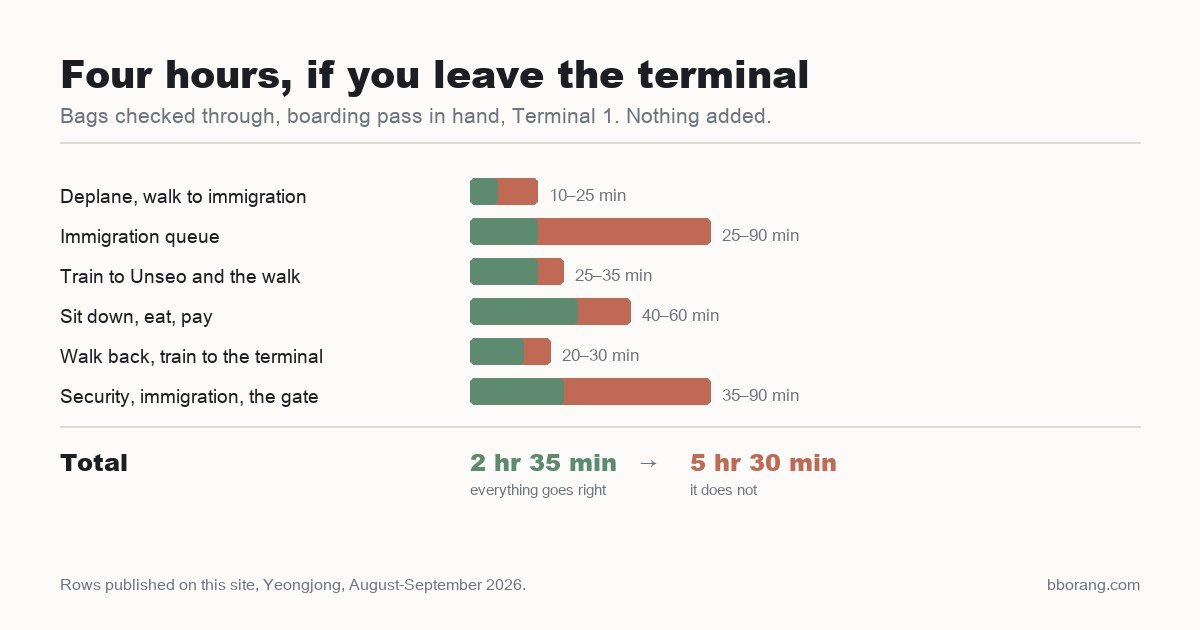
The short answer: I recommend staying airside for a 4-hour layover at Incheon Airport. A quick trip can fit a favourable scenario, but a slow return queue can erase the margin. The recommendation is conservative, not a claim that leaving is physically impossible.
I live on Yeongjong, the island the airport is built on, fifteen minutes from the terminals. I am not talking you out of coming for the sake of it. At six hours I would send you out. At four, the arithmetic below is the whole answer, and if your own times are not quite four hours, the layover calculator will run them for you.
Why does a 4-hour layover at Incheon not work?
This example is a T1–Unseo meal outing with bags checked through. Meal and airport times are allowances, not measured minimums.
| Step | Good day | Bad day |
|---|---|---|
| Deplane and walk to immigration | 10 min | 25 min |
| Immigration queue | 25 min | 90 min |
| Platform, train to Unseo, walk to the table | 25 min | 35 min |
| Sit down, eat, pay | 40 min | 60 min |
| Walk back, train to the terminal | 20 min | 30 min |
| Security, departure immigration, walk to the gate | 35 min | 90 min |
| Total | 2 hr 35 | 5 hr 30 |
The table spans 2 hours 35 minutes to 5 hours 30 minutes. Four hours lies between those scenarios; you cannot know the return queue when you decide to leave.
Do not turn the shorter scenario into a guarantee. The onward flight’s boarding cutoff is earlier than its scheduled departure, and omitted delays need room too.
The one number you cannot see when you decide
See the full airport time-budget guide for the arrival queue evidence. This page focuses on the four-hour decision rather than repeating that evidence.
Here is the part that matters at four hours specifically. You can measure the arrival queue — you stand in it, you come out the other side, you look at the clock. What you cannot measure is the one waiting for you on the way back in. Security, departure immigration and the walk to the gate ran 35 minutes on my good column and 90 on the bad one, and you find out which you got at the moment when doing anything about it is no longer possible.
The six-hour meal plan has more room, but it is still conditional. At four hours, staying airside avoids adding a second set of border formalities and a return journey.
What is already decided before you land
Bags, a new check-in and a terminal change can all add work. Check these on your booking before deciding how to spend the connection.
Confirm with your airline whether you must collect your bag at Incheon and where to check it in again. Do not infer through-checking solely from whether you bought one ticket or two. If you need storage, use the terminal-by-terminal baggage storage guide and leave time to collect your bag before check-in.
Your onward boarding pass. If you already have it, the return trip is security, immigration and a walk. If you have to check in on the way back, that queue lands on top of the 90-minute departure column, and airline check-in counters at Incheon generally close 60 minutes before departure — confirm your own carrier’s cutoff. Miss it and the aircraft leaves without you no matter how early you reached the building. A four-hour layover where you still have to check in is really a three-hour layover, measured to the counter rather than to the gate.
Unseo is 8 minutes from T1 or 14 from T2 by train, with adult transport-card fares of ₩1,200 and ₩1,800. Check both terminals before using a route time.
Use the scheduled flight times for planning, then update the available time if your inbound flight is delayed. Do not assume a scheduled arrival is the same as the moment you are outside the terminal.
Does a night-time 4-hour layover change anything?
An overnight four-hour connection is not a reason to loosen the recommendation. If trains are not running, a taxi adds another dependency. The overnight transport guide covers longer night connections.
What should you do with four hours inside the terminal?
Locate your onward gate and follow the airport’s airside transfer instructions. A landside shuttle bus is not the normal instruction for a passenger staying airside. If you need to collect a bag or check in again, confirm the route with your airline.
Do not treat a transit tour as a way around entry rules or a guarantee against missing the flight. Ask the airport’s tour service about eligibility and whether a particular tour fits; this guide does not recommend adding a landside tour to a four-hour connection.
Stay in the departure area for your onward flight, check the boarding time and use the airport’s facility directory for food or rest options nearby. This is not a personal review of the lounges, showers or transit hotels.
What if the available time changes?
Recalculate after an inbound delay or itinerary change. The layover calculator also recommends staying inside below five hours; that is a conservative recommendation, not an immigration rule.
Common questions
Can you leave Incheon Airport on a 4-hour layover?
Leaving the airport requires permission to enter Korea. Check the entry requirements and arrival-document guidance for your passport and itinerary before planning an outing.
How long does immigration take at Incheon Airport?
There is no guaranteed queue time. The airport time-budget guide explains the shorter and longer scenarios and the historical queue report.
How many hours do you need to leave Incheon Airport?
There is no universal safe threshold. This site recommends staying inside under five hours and considering one nearby meal at five to six only when the actual timing works.
Is 4 hours enough to go into Seoul from Incheon Airport?
I would not recommend it. The rail trip would take a substantial share of the connection before airport formalities and your boarding deadline.
What if my 4-hour layover is really 4 hours 30?
The extra half-hour does not remove the return-queue uncertainty. This guide and the calculator still recommend staying inside below five hours.
One last thing that costs nothing. Restaurant hours around Yeongjong change often and Google Maps is not reliable for opening hours in Korea, so check on Naver Map on the day rather than trusting any page, including this one.