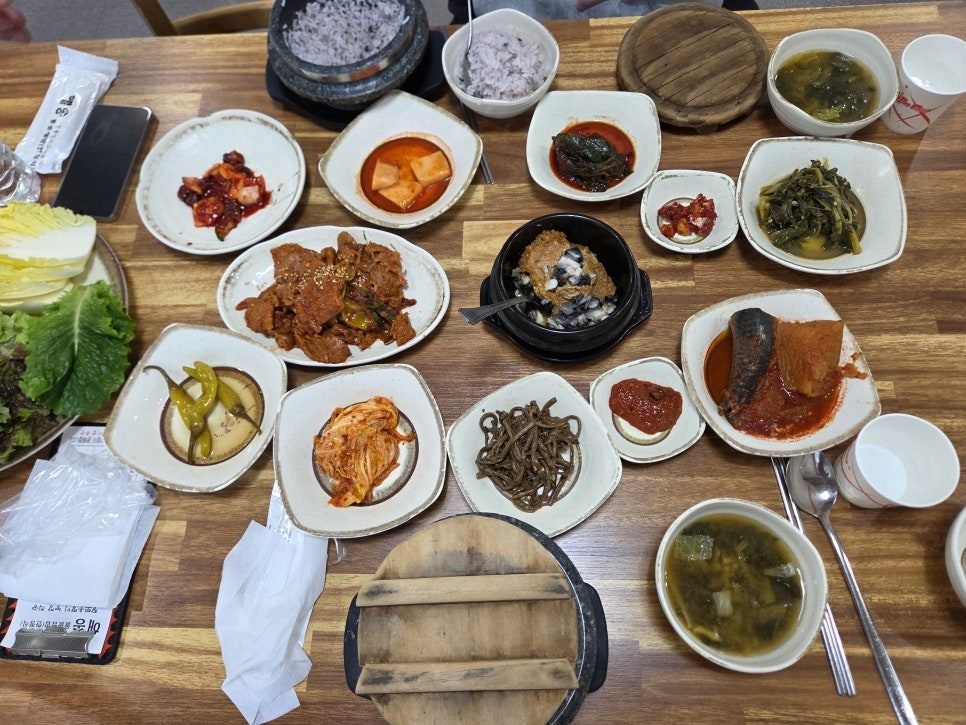
Do not plan this meal on a layover under five hours, even though the taxi ride is short. Haesong Ssambap is ten minutes from Terminal 1 by taxi — ₩8,800, 6.9 km — and it is the closest sit-down Korean set meal we have written up. What arrives is a table of about a dozen side dishes, a stone pot of rice, a plate of stir-fried pork, and a pot of ssamjang with freshwater snails in it. The greens and the side dishes refill for free.
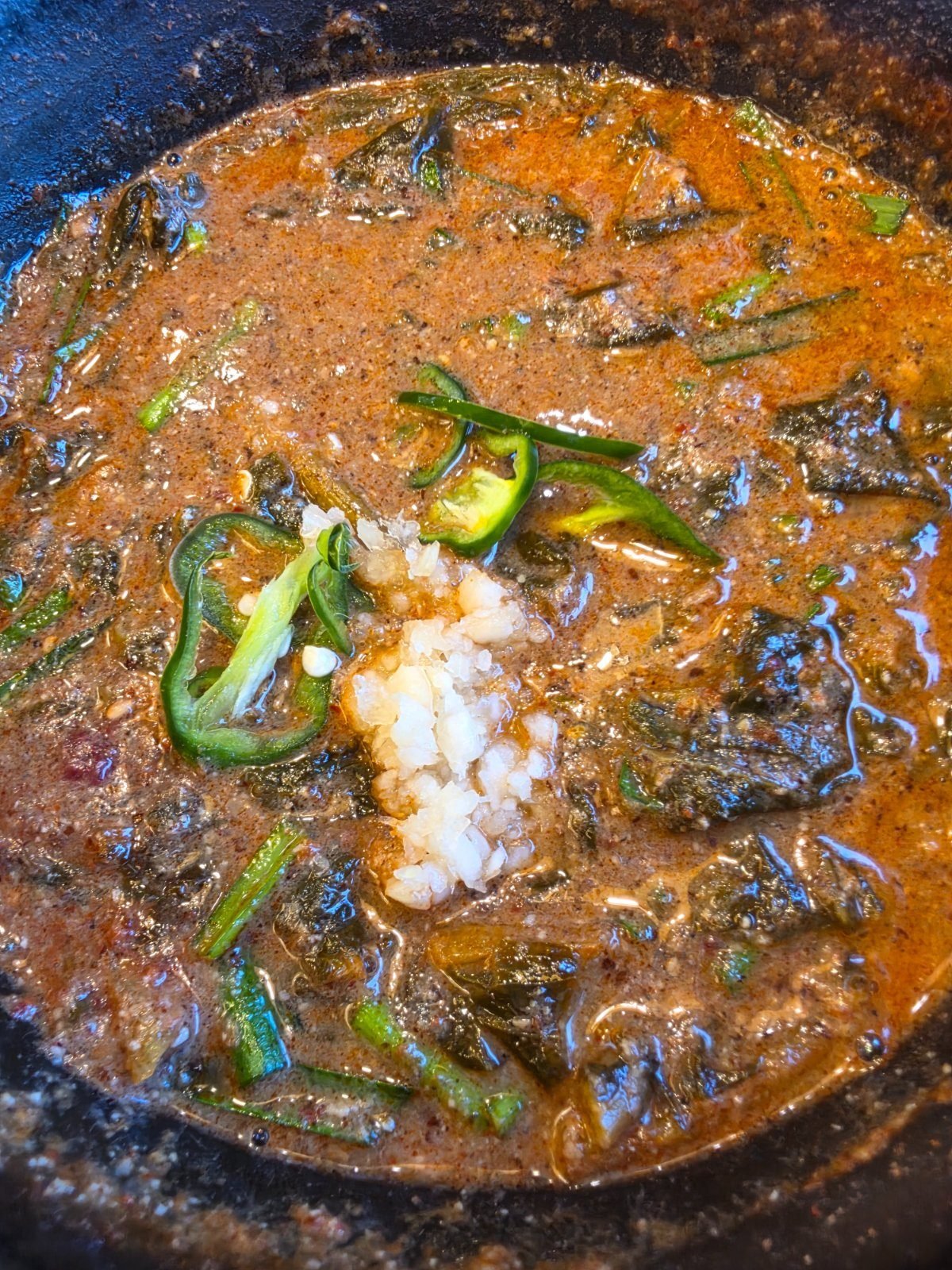
Ssambap (쌈밥) means wrap-rice. You are given leaves, rice, something to put in them, and a seasoned soybean paste to tie it together. It is a format rather than a single dish, and the version here is built around ureong ssamjang (우렁쌈장) — ssamjang with the meat of freshwater snails stirred through it.
The rice comes in a dolsot, a stone bowl, and the crust that forms on the bottom is the point of it — you scrape it up at the end. If that part interests you more than the wraps, we have written about a place near the airport that builds its whole menu around stone-pot rice.
Does it fit your layover?
Before leaving, work backwards from your airline’s check-in and boarding deadlines. Allow for the return journey, security and departure immigration, plus any baggage errands and waits for transport or a table. The airport arrival and return guide keeps the shared planning assumptions in one place; the route and menu below describe this particular restaurant.
These are the airport numbers we use across the site, plus the taxi time we looked up for this address. The eating row is an allowance, not a measurement. A ssambap set is not fast food — the table takes a few minutes to fill and you assemble every bite yourself.
Getting there
The address is 인천 영종구 공항서로 177 (Incheon, Yeongjong-gu, Gonghang-seo-ro 177). The name to show a driver or paste into Naver Map is 해송쌈밥. The phone number is 032-747-0073.
By taxi it is 10 minutes and ₩8,800 from Terminal 1, or 16 minutes and ₩12,400 from Terminal 2 — the T2 drive is 11.6 km against 6.9 km, which is where the extra fare goes.
By bus, take the 306 from the Terminal 1 stop on the third floor, platform 7. It is 20 minutes to 스타파이브입구 (Star Five Ipgu), then a two-minute walk. With the walk at the airport end, budget 25 minutes and ₩1,900. From Terminal 2 you ride the AREX one stop to Terminal 1 first — six minutes — then pick up the same bus, which comes to about 32 minutes and ₩3,100. Buses out here are not frequent, so check the next departure in Naver Map before you commit to one, and pay with a T-money card, available at participating convenience stores.
Leave your suitcase behind. This is a full sit-down meal rather than a counter you pass through, and the staffed storage counters at both terminals exist precisely so you are not steering a case around a restaurant floor.
What you order
There is effectively one decision. The set — 우렁쌈밥정식, the freshwater-snail ssambap set — is ₩20,000 per person on the restaurant’s Naver listing, with a children’s portion at ₩8,000. Skate is the only other thing on the board, at ₩20,000 and ₩30,000 depending on size. Prices move; treat these as the shape of the bill rather than the bill.
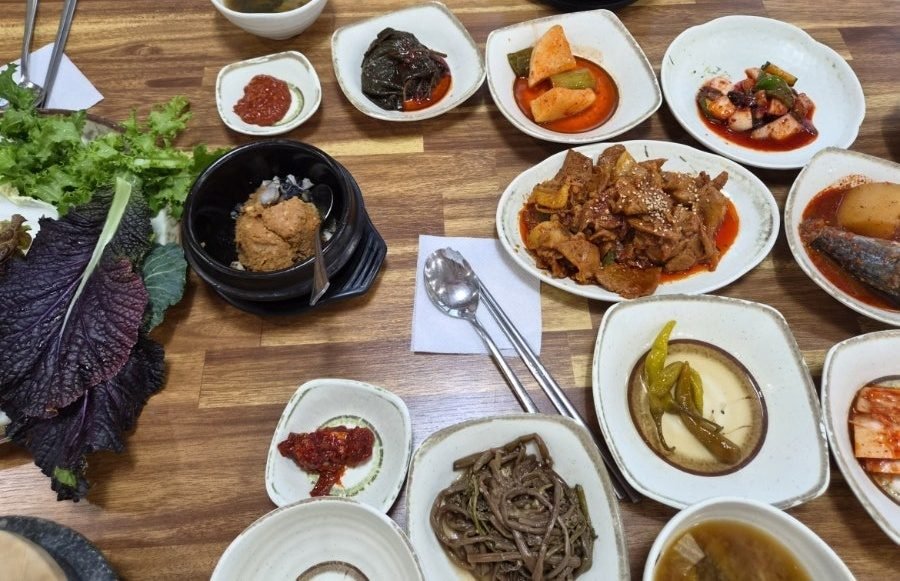
Assembly is the whole meal. Take a leaf, or two stacked, add a spoon of rice, a piece of pork, and a dab of the ssamjang, then fold it and eat it in one. The paste here has nuts ground into it, which makes it more savoury than salty — it is the thing the regulars come back for, and it is worth using more of it than you think.
The greens and the side dishes are unlimited and free to refill, which is the part that catches visitors out. You do not order a second round of anything. If the leaves run low, the staff bring more. Refills are normal across Korea, but it matters more here than usual because the leaves are the meal — a table that runs out of lettuce is a table that has stopped eating. We have written separately about restaurants near the airport where the side dishes are the entire point.
At the end, ask for hot water for the stone pot. Poured over the crust stuck to the bottom, it turns into sungnyung — a toasted-rice tea you drink straight from the bowl. It is free and it is the intended finish.
Things worth knowing before you go
It is closed on Mondays. This is the one that will actually ruin your plan. Hours are 10:30 to 21:00 the rest of the week, and the last order is 19:40 — earlier than the closing time suggests, so an evening layover needs you seated by half seven.
There is no afternoon break. Many Korean restaurants shut between lunch and dinner; this one does not, so a two o’clock arrival is fine.
The ssamjang is not vegetarian and neither is the set. Ssambap looks like a vegetable meal and it is not one — snails in the paste, pork on the plate. If that rules it out for you, what a vegetarian can actually eat around Incheon Airport is a separate problem we have worked through.
Cards work, as they do everywhere in Korea, and there is no tipping and no service charge. Water and cutlery are usually self-serve in restaurants of this kind, so look for the station rather than waiting to be brought them. Nobody will think anything of you eating alone, though the set is priced and portioned per person, so a solo diner still pays the full ₩20,000.
We have not seen an English menu or a picture menu here, so if you want the ordering problem solved in advance, the phrases and the pointing that work in Korean restaurants cover it. Saying ssambap dul-juseyo (쌈밥 둘 주세요) — two ssambap, please — is enough here, because there is only the one set.
Our verdict
Go if you want one proper Korean meal on a short layover and you are travelling with someone. Twenty thousand won each is not cheap against the noodle and stew places we usually point people at, but you are paying for a dozen dishes and unlimited greens rather than a bowl, and the ten-minute drive means the clock is not the thing you are managing.
Skip it if you are alone and counting won, if you want to be in and out in half an hour, or if it is a Monday. A set meal you assemble by hand is the wrong shape for a rushed eater — that is not a criticism of the food, it is a mismatch of format.
FAQ
How far is it from Incheon Airport?
Ten minutes and ₩8,800 by taxi from Terminal 1, or 16 minutes and ₩12,400 from Terminal 2. By bus it is the 306 from Terminal 1, about 25 minutes door to door for ₩1,900.
What is ureong ssamjang?
Seasoned soybean paste with the meat of freshwater snails stirred into it. The version here also has ground nuts in it, which is why it reads as savoury and nutty rather than sharply salty.
Are the refills really free?
Yes. The wrapping greens and the side dishes refill at no charge, which is standard practice in Korea and not something you need to ask permission for.
Can I go on a Monday?
No — it takes a regular day off every Monday. Check the hours in Naver Map on the day you travel anyway, because small restaurants here also close for holidays without much notice.
Is four hours really enough?
No: this guide recommends staying inside on a four-hour connection. Airport procedures, waiting and boarding deadlines still need time beyond the drive and meal. A short drive alone is not enough margin.
Updated 17 September 2026: layover advice revised to distinguish planning scenarios from a guaranteed return time. This guide recommends staying inside the airport on connections under five hours.