The short answer: a 10-hour layover at Incheon Airport offers more choices, but it does not guarantee a day trip. Compare a nearby meal, Masian Beach, Seoul and the more demanding Ganghwa outing against the time left after airport formalities.
The spread between those two numbers is the whole problem, and it comes down to what time and what day you land. The layover calculator works it out against your own two times rather than against an average.
How much of a 10-hour layover do you actually get?
Start by taking the airport’s cut off the top. This is everything that happens before you are outside and after you come back, with nothing in it for the thing you actually came to do.
| Step | Good day | Bad day |
|---|---|---|
| Deplane and walk to immigration | 10 min | 25 min |
| Immigration queue | 25 min | 90 min |
| Baggage claim (skip if checked through) | 0 min | 35 min |
| Drop your bag at storage | 0 min | 20 min |
| Security, departure immigration, walk to the gate | 35 min | 90 min |
| The airport’s cut | 1 hr 10 min | 4 hr 20 min |
| What is left of ten hours | 8 hr 50 min | 5 hr 40 min |
The airport allowances come from the arrival-to-gate planning model. They are scenarios, not forecasts for a particular nationality, season or weekday.
One thing the table does not include: your ten hours are measured from scheduled landing to scheduled departure, and you need to be at the gate well before that second number. If you still have to check in, airline counters at Incheon generally close 60 minutes before departure, and everything above has to be built backwards from that moment.
What can you do with 10 hours at Incheon Airport?
Four options to compare. Daylight, tide times, entry eligibility and return transport can rule out an option even on a long connection.
| Where | How you get there | Door to door, good day → bad day |
|---|---|---|
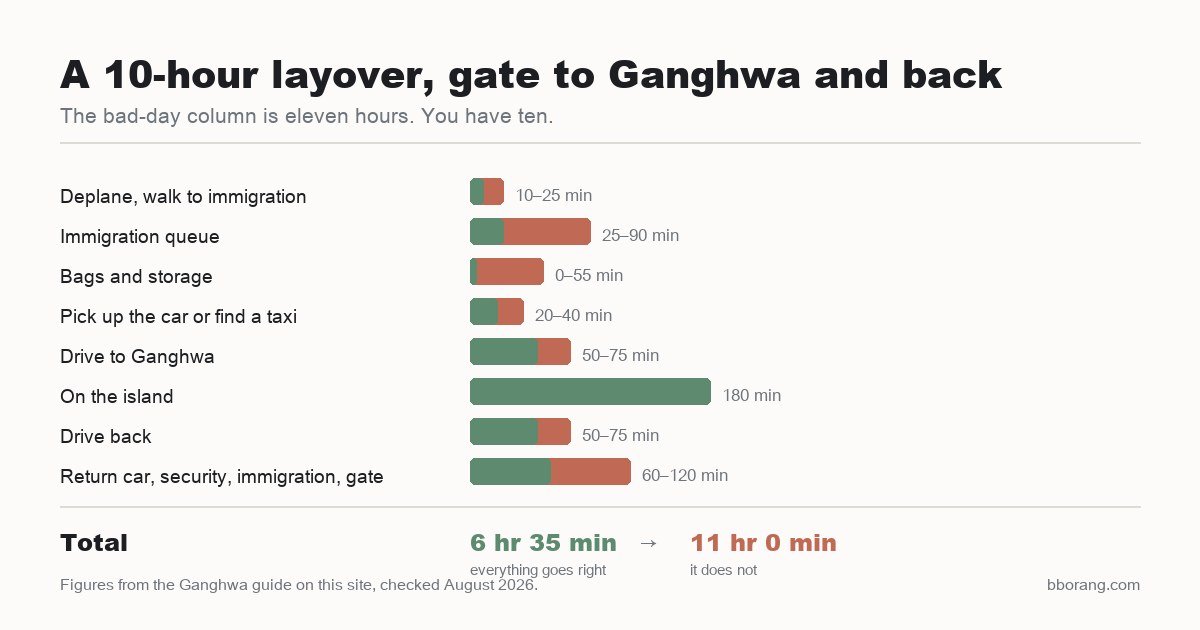
| Ganghwa Island | Rental car or taxi, 50–60 min each way. No direct public transport. | about 6 hr 35 → 11 hr |
| Masian Beach and the mudflat | Taxi, 12 min from Terminal 1, 20 from Terminal 2 | about 6 hr → 9 hr 45 |
| A meal in Unseo | AREX all-stop, 7–8 min and ₩1,200 from Terminal 1 | about 3 hr |
| Seoul Station | AREX all-stop, 55 min and ₩4,750 from Terminal 1 | 2 hr of travel before you have seen anything |
Ganghwa’s longer scenario exceeds ten hours. A longer connection is not a substitute for checking the return journey.
Is Ganghwa Island worth it on a 10-hour layover?
Ganghwa is the most demanding option here. Consider it only with a workable car or taxi return and substantial margin; ten hours alone is not enough to recommend it.
Ganghwa (강화도) is 54 kilometres from the airport, fifty minutes to an hour by road, and it is the only place within reach of a layover where you can look across the estuary at North Korea without booking a DMZ tour. The Peace Observatory costs around ₩2,500 and sits inside a civilian control zone, so your passport gets checked on the way in. The dolmens are UNESCO-listed, sit in open fields and are free. Jeondeungsa temple is free. Joyang Bangjik, a 1930s textile mill turned into a cafe with the machinery left where it stood, is the one everybody photographs.
The problem is the road. There is no airport bus, no train and no single-bus route to Ganghwa — public transport means going inland and coming back out, roughly two hours each way. So it is a rental car or a taxi at ₩50,000–70,000 each way. A rental car needs an International Driving Permit issued in your own country before you travel; you cannot get one after you land.
Six and a half hours if the day cooperates. Eleven if it does not — and eleven does not fit inside ten. That is the honest shape of this trip, and it means Ganghwa is a yes only when three things are already true: your bags are checked through, you hold your onward boarding pass, and you are not landing at midday in July. The full guide to getting from Incheon Airport to Ganghwa Island has the sites, the fares and the return-leg problem in detail. If any of the three is missing, spend the ten hours on Yeongjong instead — you will see more of it.
Does the Masian mudflat work on a 10-hour layover?
A longer connection gives you more room to work around the tide, but it cannot guarantee that digging is available during your visit.
Masian (마시안해변) is twelve minutes by taxi from Terminal 1 and twenty from Terminal 2, on the west side of Yeongjong. The beach costs nothing. The organised mudflat charges ₩10,000 for adults, ₩5,000 for primary-school children and ₩3,000 for younger ones, with boots at ₩2,000, a hand hoe at ₩1,000 and a ₩10,000 deposit on the vest. You are limited to two kilos of shellfish per person.
Check the actual activity window before leaving the airport. If it does not overlap your available time, choose the beach or cafe instead. The Masian guide covers the activity separately from the beach visit.
If the tide is wrong, the trip is still worth making for the cafe on the slope above the beach — every seat faces the water and the salt bread was ₩4,500 on the price card in July 2026. Emcliff, the ocean view cafe above Masian, is the fallback that does not depend on the sea doing anything in particular.
Should you go into Seoul on a 10-hour layover?
Seoul becomes easier to consider with a longer connection. Choose one neighbourhood and calculate the trip from your own terminal rather than treating ten hours as a fixed threshold.
The all-stop AREX train runs from Terminal 1 to Seoul Station in 55 minutes for ₩4,750, and from Terminal 2 in 60 minutes for ₩5,350; add about five minutes at each end for the platform and the exit. Call it an hour each way, checked September 2026. Take two hours of travel off the bottom row of the table above and a good day leaves you close to seven hours in the city. A bad day leaves you three and a half.
Three and a half hours in Seoul means one neighbourhood, one thing in it, and a train back. Seoul is enormous, and on a layover you will see maybe two things before you have to turn around. I moved out here after fifteen years of living in it, so this is not a case of talking the city down to keep you nearby — it is that Seoul rewards a day and punishes an afternoon.
Pick one place near a convenient rail stop and set the return time against your airline’s deadlines. If you collect a bag, include storage and collection rather than assuming they fit for free.
What should you sort out before you leave the terminal?
Confirm with your airline whether you must collect your bag at Incheon and where to check it in again. Do not infer through-checking solely from whether you bought one ticket or two. If you need storage, use the terminal-by-terminal baggage storage guide and leave time to collect your bag before check-in.
Leaving the airport requires permission to enter Korea. Check the entry requirements and arrival-document guidance for your passport and itinerary before planning an outing.
Download Naver Map while you have airport Wi-Fi. Use the Korean place name or address shown in the restaurant guide to check the route, next departure and opening hours. Google Maps pins can help identify a place; check the journey in Naver Map before leaving.
What goes wrong on a 10-hour layover?
The queue, which you cannot control, and the return leg, which you can. Ganghwa is the one that catches people: you can get a taxi out there easily and there is nothing to flag down on the way back. Arrange the return with the same driver or use a hailing app and allow for a wait.
The other one is darkness. A ten-hour layover often straddles the night, and most of this page is daytime — the mudflat, the maglev, the sunset and Ganghwa’s viewpoints all need light, and the last AREX train from Terminal 1 leaves at 23:56. If your ten hours land mostly in the dark, the honest answer shrinks to one thing: the 24-hour restaurant two minutes from Unseo station is the only place on this island I can point to at four in the morning.
Terminal differences depend on the destination: Masian taxi times are about 12 minutes from T1 and 20 from T2. The recorded Seoul Station train rides are 55 and 60 minutes. Compare T1 and T2 routes rather than adding a blanket allowance.
Common questions
Can you leave Incheon Airport on a 10-hour layover?
Leaving the airport requires permission to enter Korea. Check the requirements for your passport and itinerary before travel. The e-Arrival Card is not required of everyone: valid K-ETA holders are generally exempt, while entering on a visa can change that requirement. Use the official e-Arrival Card navigator to check your case.
Is 10 hours enough to go into Seoul from Incheon Airport?
Arithmetically yes. The train is 55 minutes each way from Terminal 1, so about two hours of the layover goes on travel. After the airport’s own overhead that leaves close to seven hours in the city on a good day and about three and a half on a bad one. Three and a half hours is one neighbourhood and nothing else.
Is 10 hours enough for Ganghwa Island?
Only with a car or a taxi, and only if the day goes well. The round trip runs about six and a half hours when everything works and about eleven when it does not, and eleven does not fit inside ten. There is no direct public transport from the airport to Ganghwa.
How much does the train from Incheon Airport to Seoul Station cost?
₩4,750 on the all-stop line from Terminal 1 and ₩5,350 from Terminal 2, checked September 2026. The journey is 55 and 60 minutes respectively. A T-money card works, and so does a single-journey ticket from the machines at the station.
What if your 10-hour layover is overnight?
Then most of this page does not apply. The beach, the mudflat and Ganghwa are daytime trips, and the airport train stops running just before midnight from Terminal 1. Food is the realistic answer, and there is one place near Unseo station that never closes.