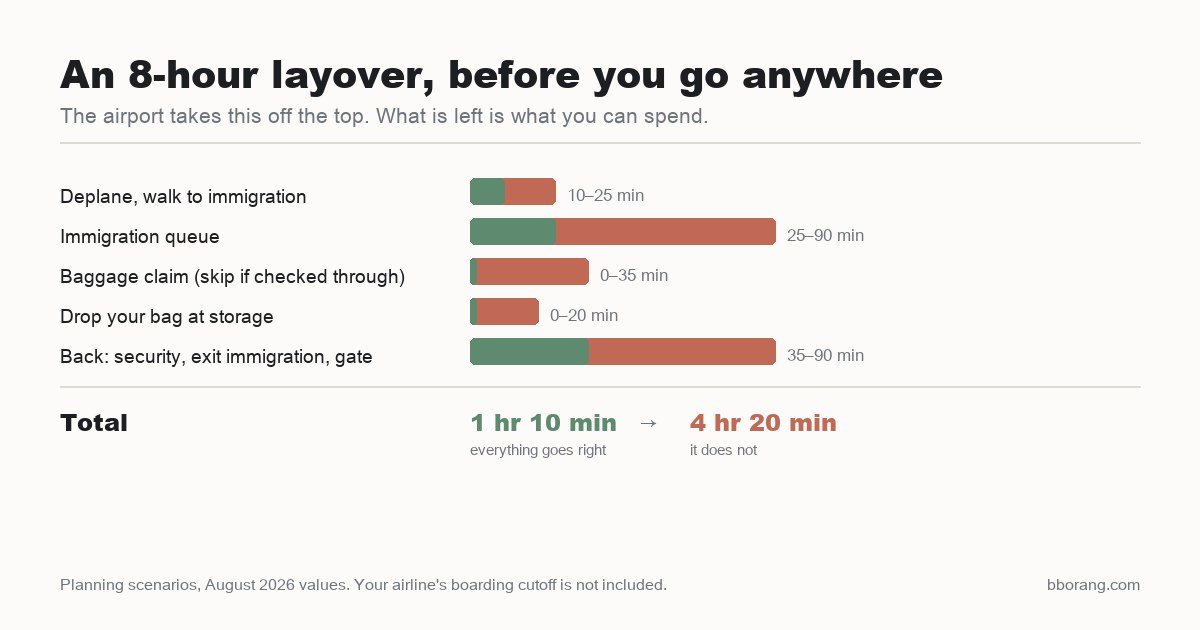
Six hours and up, this one works. Under six, don’t — not because the drive is long, but because the food takes its time. Ttomanna Jogae Susan (또만나 조개수산) sits on Jamjindo, 11 minutes and ₩9,000 by taxi from Terminal 1, which puts it a minute closer to the arrivals hall than Masian Beach. The main dish is kalguksu, knife-cut noodles, boiled at your table in a pile of clams.
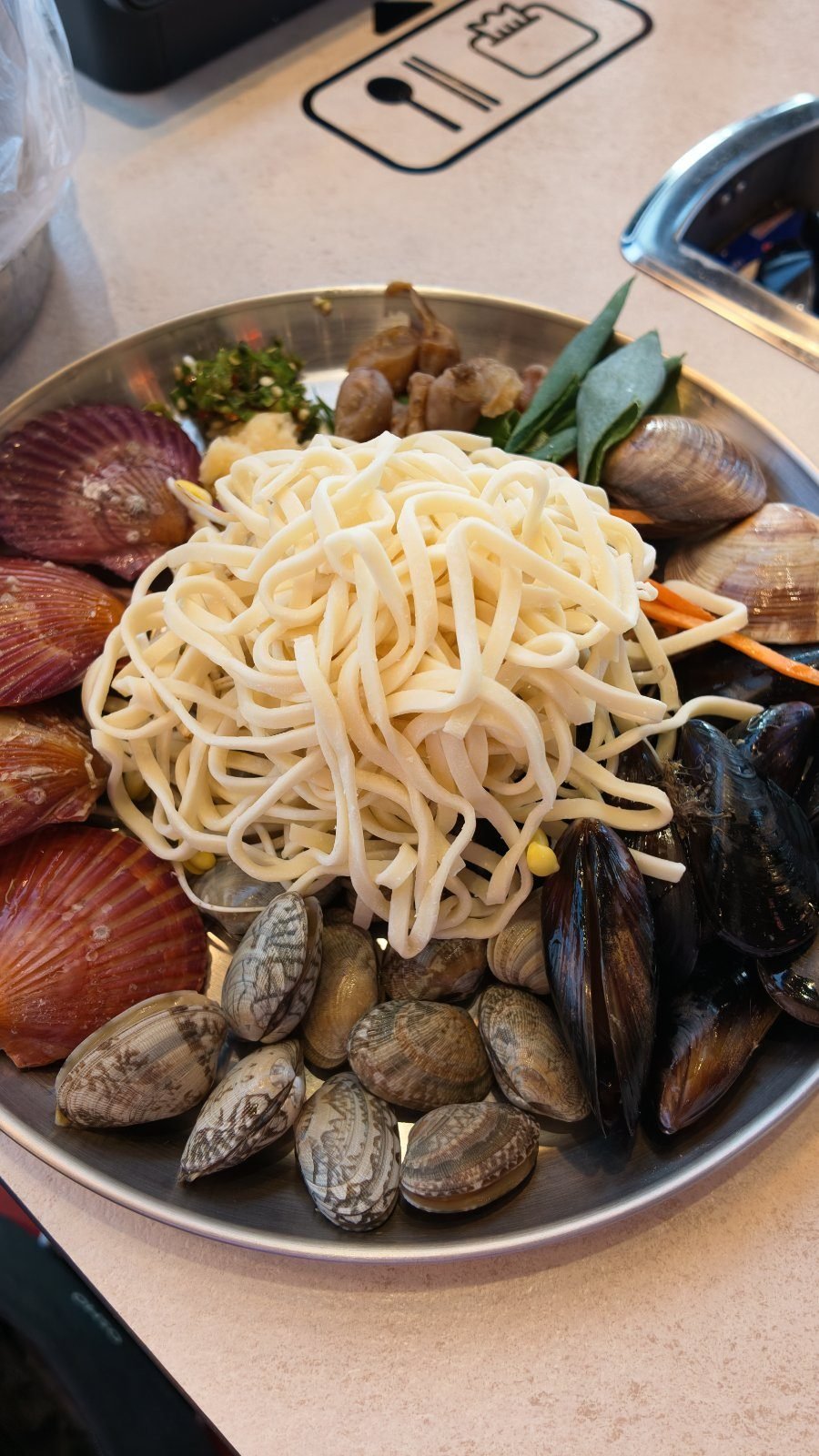
Most English guides translate kalguksu as “Korean noodle soup” and stop there. The version here arrives raw: a steel platter of scallops, mussels and Manila clams with a mound of fresh noodles on top, and a gas burner under it. The noodles are extruded when the order goes in, not pulled from a bag, and you can feel it — they’re thick and they hold a chew that factory noodles don’t.
Does it fit your layover?
The drive is short. The meal isn’t, and that’s the part people misjudge. The pot keeps boiling the whole time you eat, so you’re not waiting on a kitchen — you’re waiting on a burner, and then eating the noodles before they swell. Budget an hour at the table and you’ll be relaxed; budget forty minutes and you’ll be watching the clock.
| Step | Good day | Bad day |
|---|---|---|
| Deplane to the immigration hall | 10 min | 25 min |
| Immigration queue (foreign passports) | 25 min | 90 min |
| Taxi, Terminal 1 to Jamjindo | 11 min | 11 min |
| Eating (allowance, not a measured time) | 60 min | 60 min |
| Taxi back to Terminal 1 | 11 min | 11 min |
| Security on the way back | 15 min | 40 min |
| Departure immigration | 10 min | 30 min |
| Walk to the gate | 10 min | 20 min |
| Total | about 2 h 32 m | about 4 h 47 m |
The eating row is an allowance, not a stopwatch reading, so the totals are approximate. On a bad arrival day the whole thing runs close to five hours, which is why six is the floor. If you’re landing with less than that, a meal near the station makes more sense than a meal by the water — the soup house two train stops from Terminal 1 is the version of this that fits a short connection. And if you haven’t decided whether to leave the airport at all, the time math on leaving Incheon during a layover is the thing to read first.
Getting there
Taxi is the honest answer. From Terminal 1 it’s 11 minutes, 7.3 km, ₩9,000. From Terminal 2 it’s 18 minutes, 18.7 km, ₩17,400 — Terminal 2 is on the wrong side of the island for this, and the fare nearly doubles.
There is a bus, and unusually for the west coast it’s a reasonable one. The Muui 1 (무의1) leaves from platform 7 on the third floor of Terminal 1, runs 25 minutes, and drops you at Jamjindo-ipgu (잠진도입구), one minute’s walk away. Door to door it’s 29 minutes for ₩1,200 with a T-money card. That’s ₩7,800 cheaper than the taxi for eighteen extra minutes. The catch is frequency: this is a village route, not an airport shuttle, and the gap between buses is long enough to eat your whole margin. Check the next departure in Naver Map before you commit to it, and if the wait is more than about ten minutes, take the taxi.
From Terminal 2, the bus means riding AREX one stop to Terminal 1 first and picking up the Yeongjong 8 (영종8) — 40 minutes, ₩2,400. At that point the taxi is worth the money.
Finding the door
This is the part that catches people. The restaurant is on the third floor and the roof, and the ground floor is a bakery café called Daily Celeb (데일리셀럽). You walk in through the bakery and take the lift up. The way up is through the bakery, so if you’re standing on the street hunting for a restaurant door, that’s why you can’t find it.
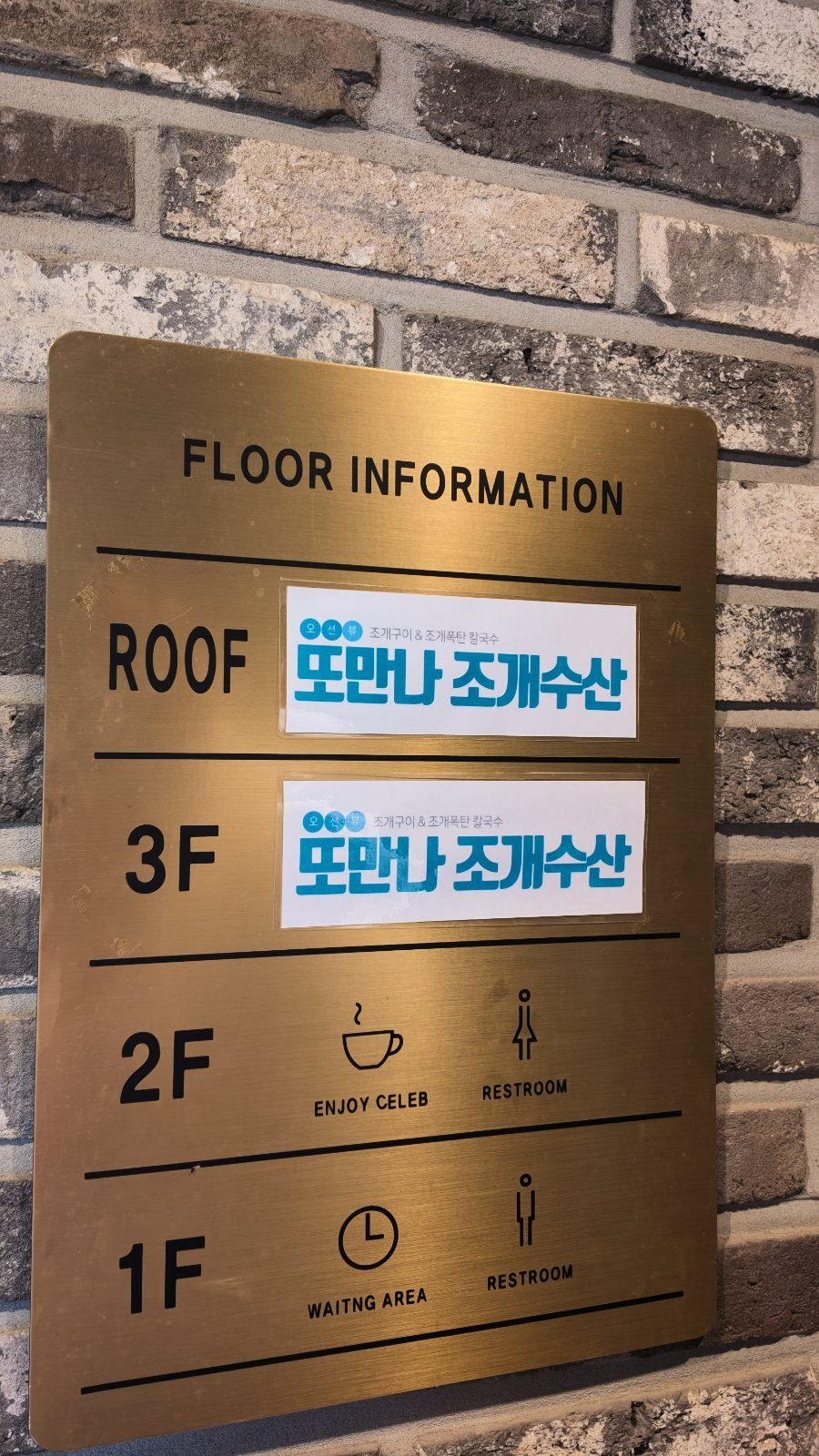
The floor plate is in Korean apart from the floor numbers, but the numbers are the only part you need. Look for 또만나 조개수산 next to 3F. The roof is the same restaurant — terrace seating, same menu.
Ordering without Korean
Every table has a tablet and you order from it yourself. No one comes to take your order and no one expects you to speak. The tablet is in Korean, but the dishes are photographed, and what you’re pointing at is unambiguous once you know the two names: the clam pot is 조개폭탄 칼국수 and the octopus is 불쭈꾸미. We had them as a set together, which is how they’re meant to go.
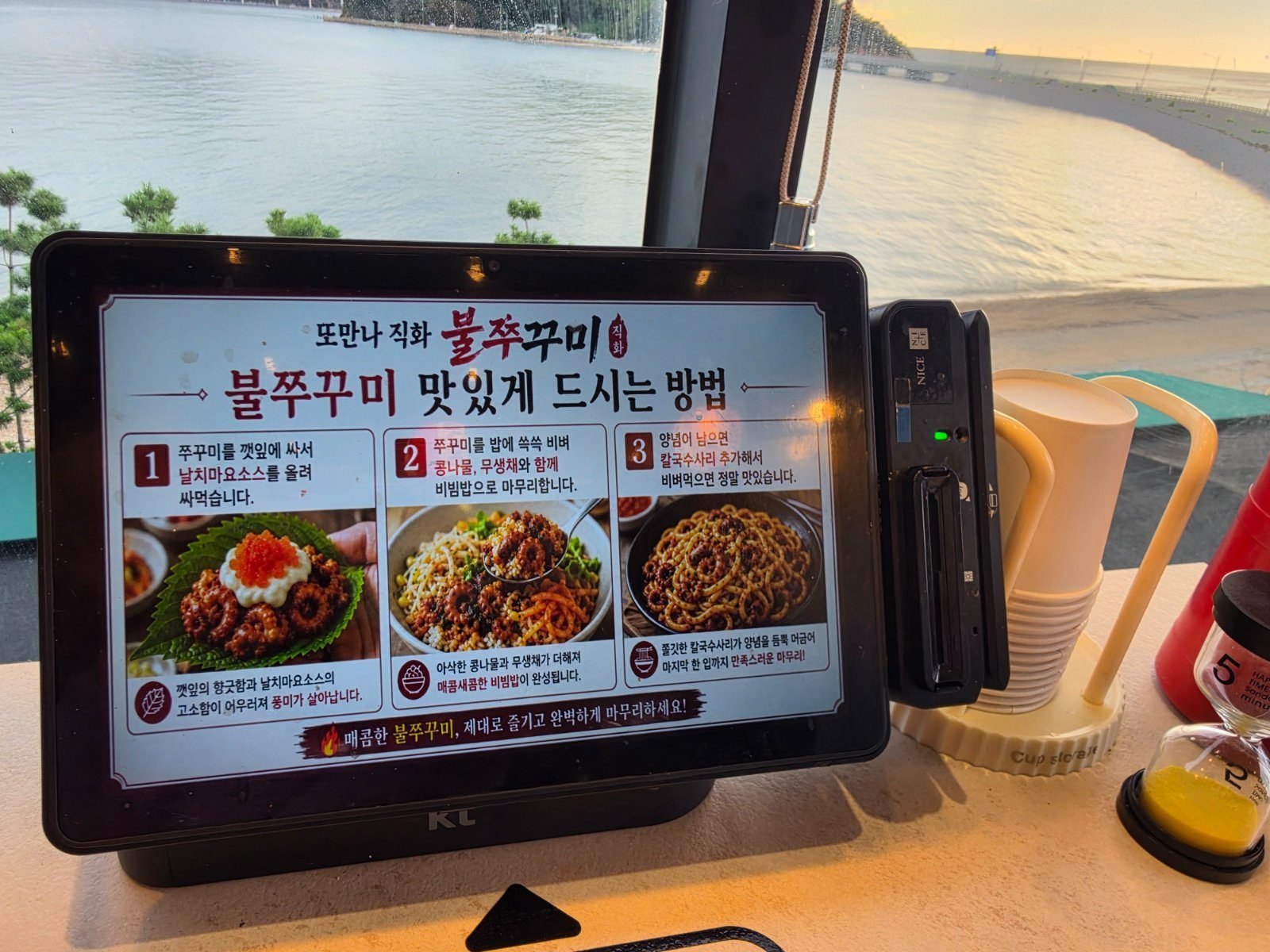
The card on the tablet is a three-step picture guide to the octopus, and the pictures carry it even if the text doesn’t. Step one: wrap a piece in a perilla leaf and spoon the roe-mayo over it. Step two: mix the rest through rice with the bean sprouts and the shredded radish. Step three: drop noodles into whatever sauce is left. You can follow all three off the photographs alone.
One thing worth deciding before you tap: spice level. Ordering the mild version (보통맛, botong-mat) still gives you a dish with heat in it, and once it’s mixed through rice it lands about right rather than flat. If you don’t eat chilli well, take the mild one — it isn’t a compromise version.
What comes with it
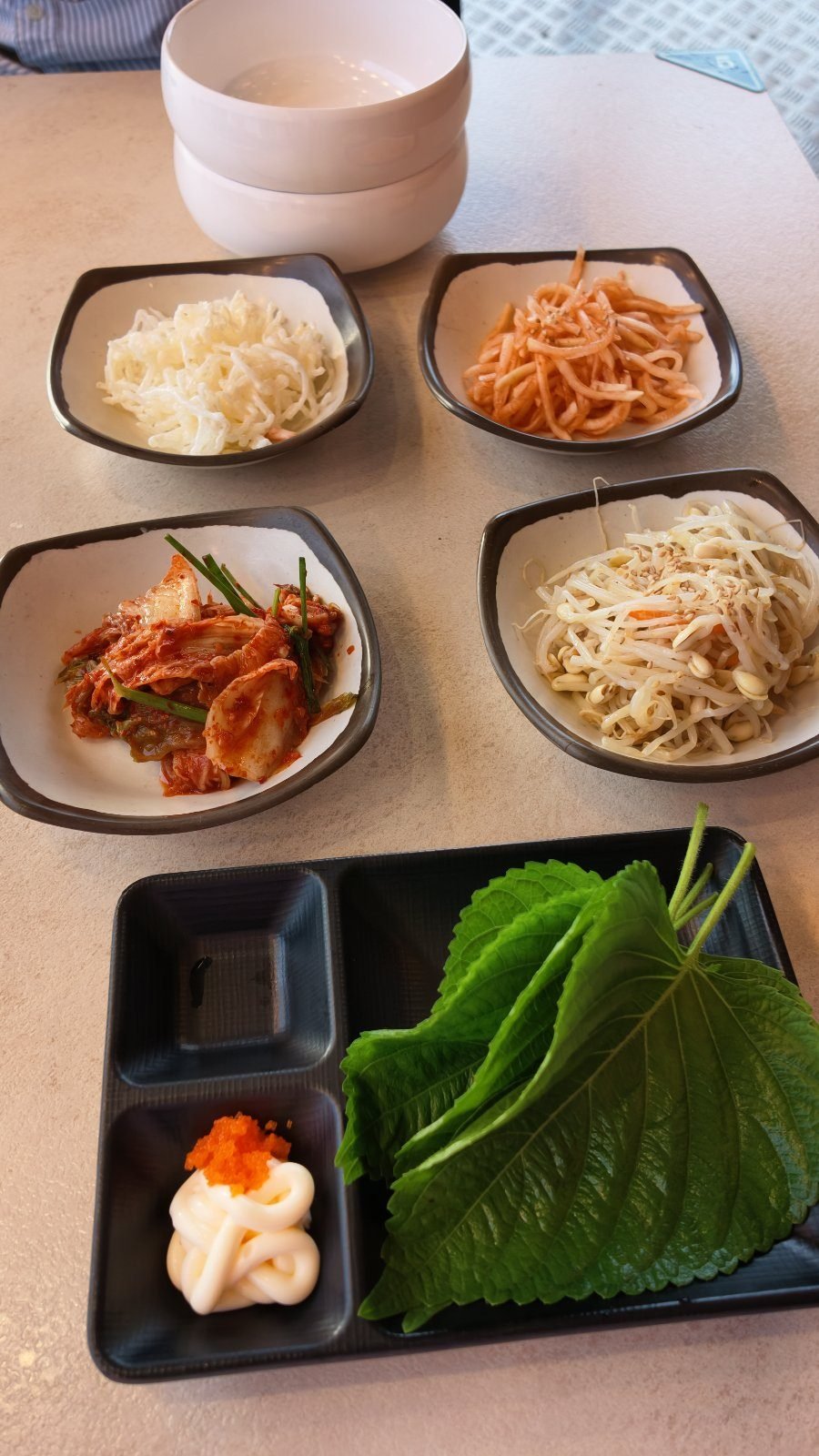
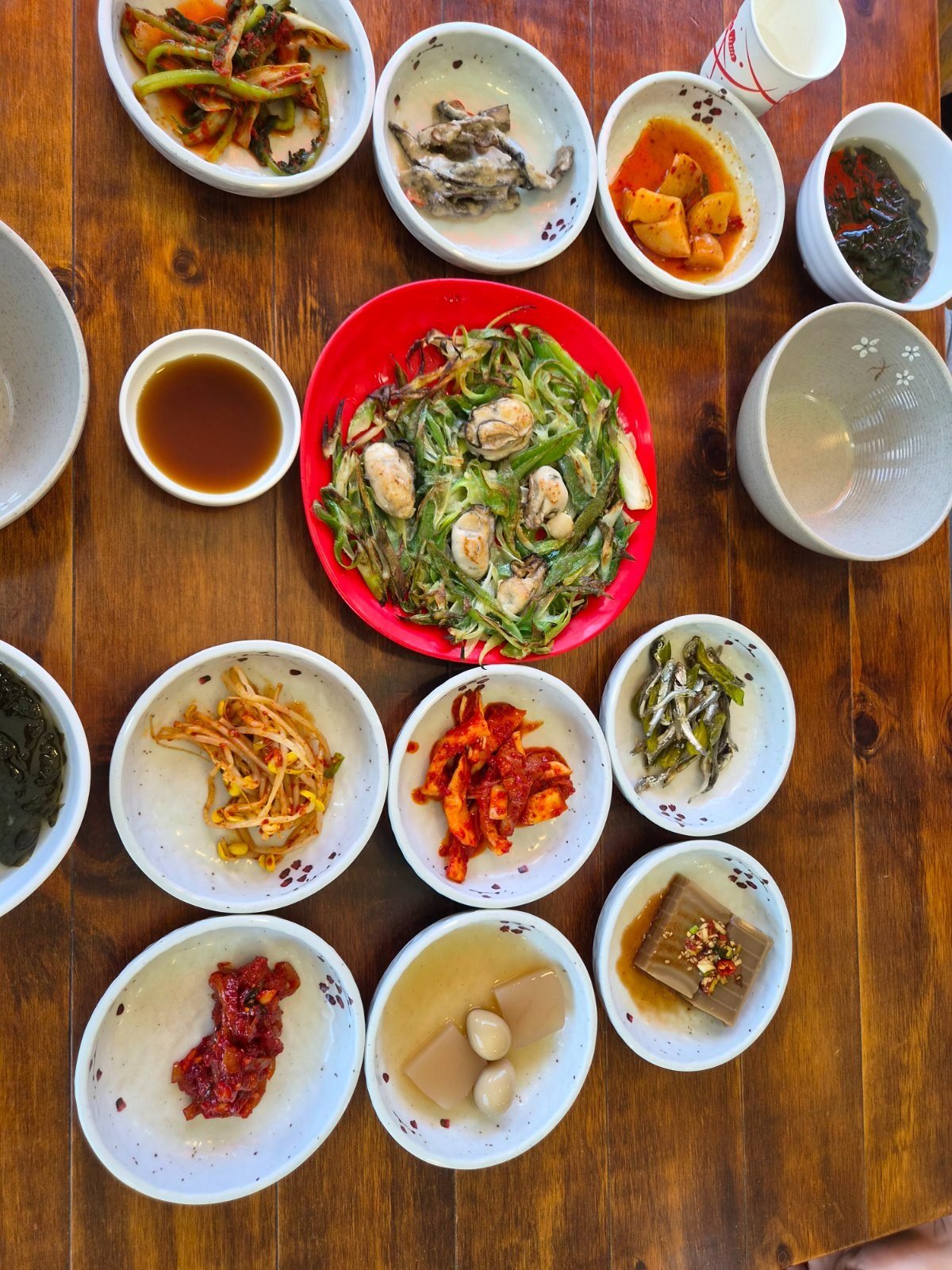
The side dishes come without being ordered and without being charged for: pickled onion, dressed dried squid, fresh-cut kimchi and seasoned bean sprouts, plus a tray of perilla leaves and lettuce for wrapping. Refills are free too — this is standard across Korea and nobody will think you’re being cheeky for asking. The white sauce with orange roe on top isn’t a dip for the noodles; it goes on the octopus inside the leaf.
Water, cups and cutlery are self-service, which is normal here. There’s no tip and no service charge, and a card works for the bill the same as it does everywhere else in the country — you don’t need to carry cash on a Korean layover for a meal like this.
The octopus
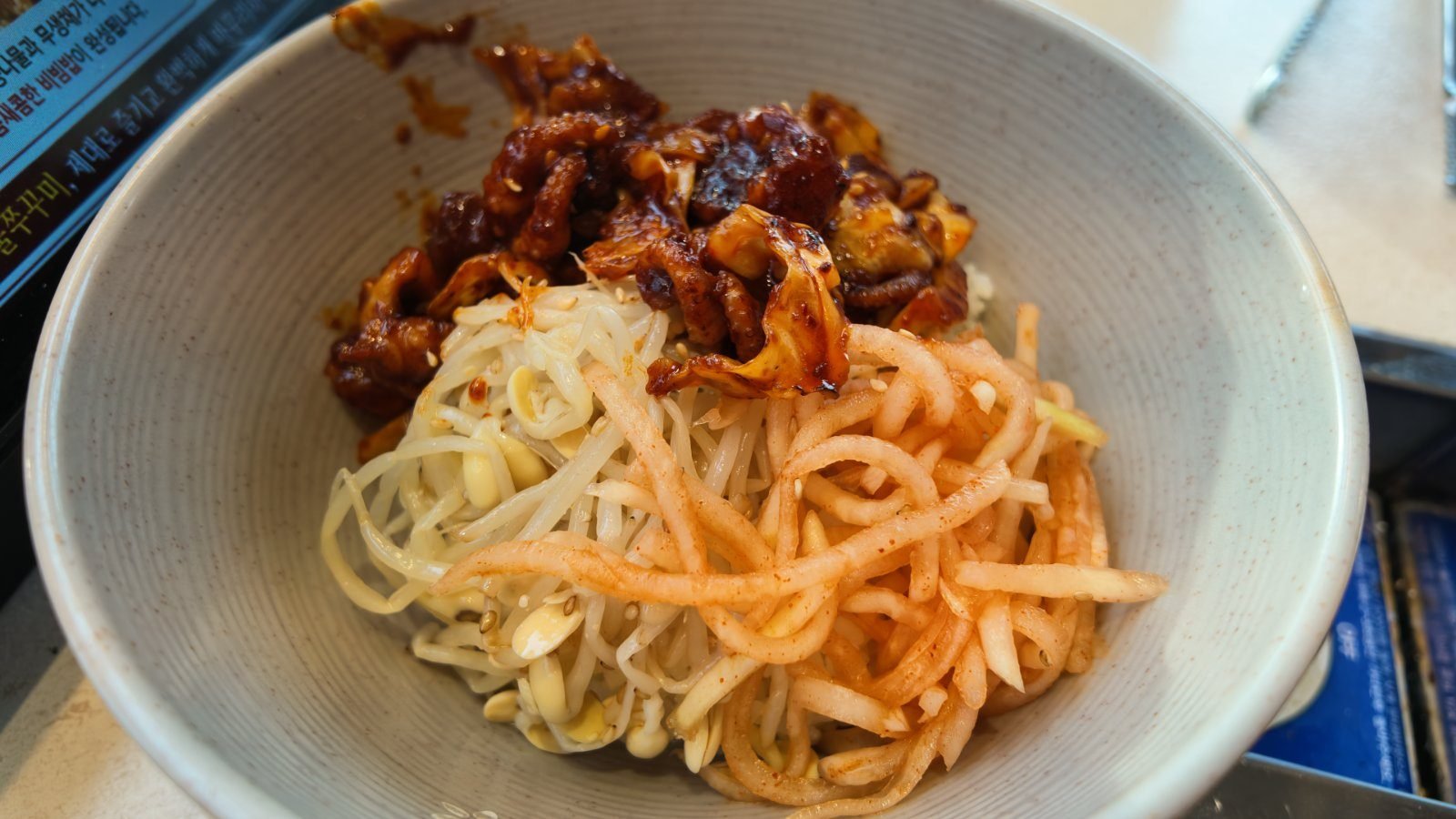
Jjukkumi is webfoot octopus — small, and here left whole rather than chopped, so you get a proper chew instead of fragments. It’s grilled over direct flame and it tastes it; there’s a smoke on it that a pan doesn’t produce. The sauce clings rather than pools.
The best mouthful of the meal was the wrap: rice on a perilla leaf, a piece of octopus, bean sprouts on top. Perilla has a sharp herbal edge that cuts the chilli, and that combination is the reason the leaves are on the table.
The clam pot
The broth underneath is prawn-based rather than anchovy, and it’s noticeably not salty — it runs clean and cold-tasting even boiling hot, which is why it works as the thing you go back to between mouthfuls of chilli. The clams are the point as much as the noodles: the mussels and Manila clams have real meat in them and no muddy edge, and prying them open one at a time is half the entertainment.
The one thing to watch is the burner. It doesn’t switch off when the noodles are ready, so the pot keeps cooking while you sit there. Eat the noodles first and let the clams and broth wait — reverse that and you’ll be fishing out something closer to porridge.
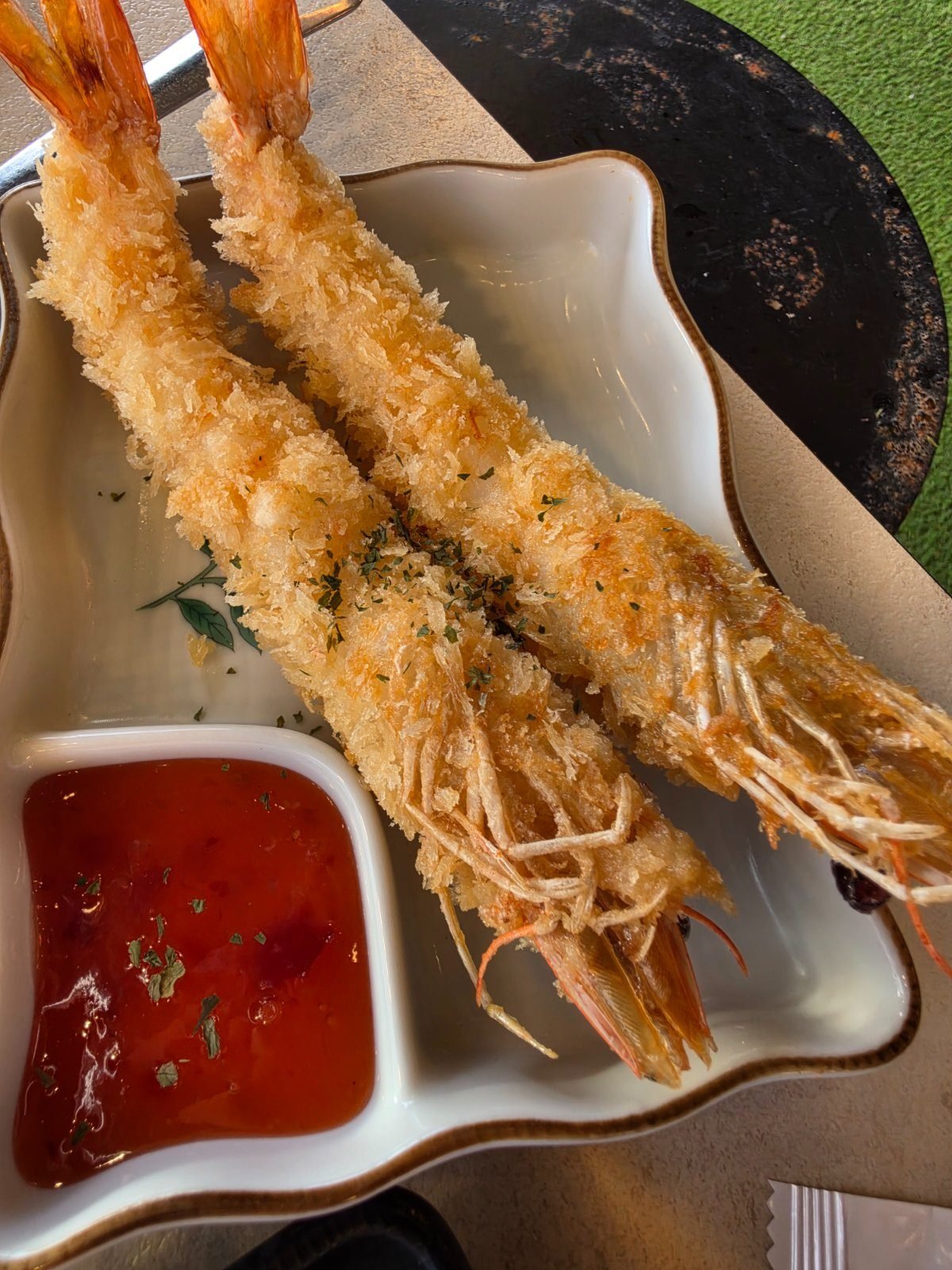
The set also brings two fried king prawns. They’re long, the crumb is properly crisp, and their real job is to reset your mouth after the octopus.
The view, and whether it’s the reason to go
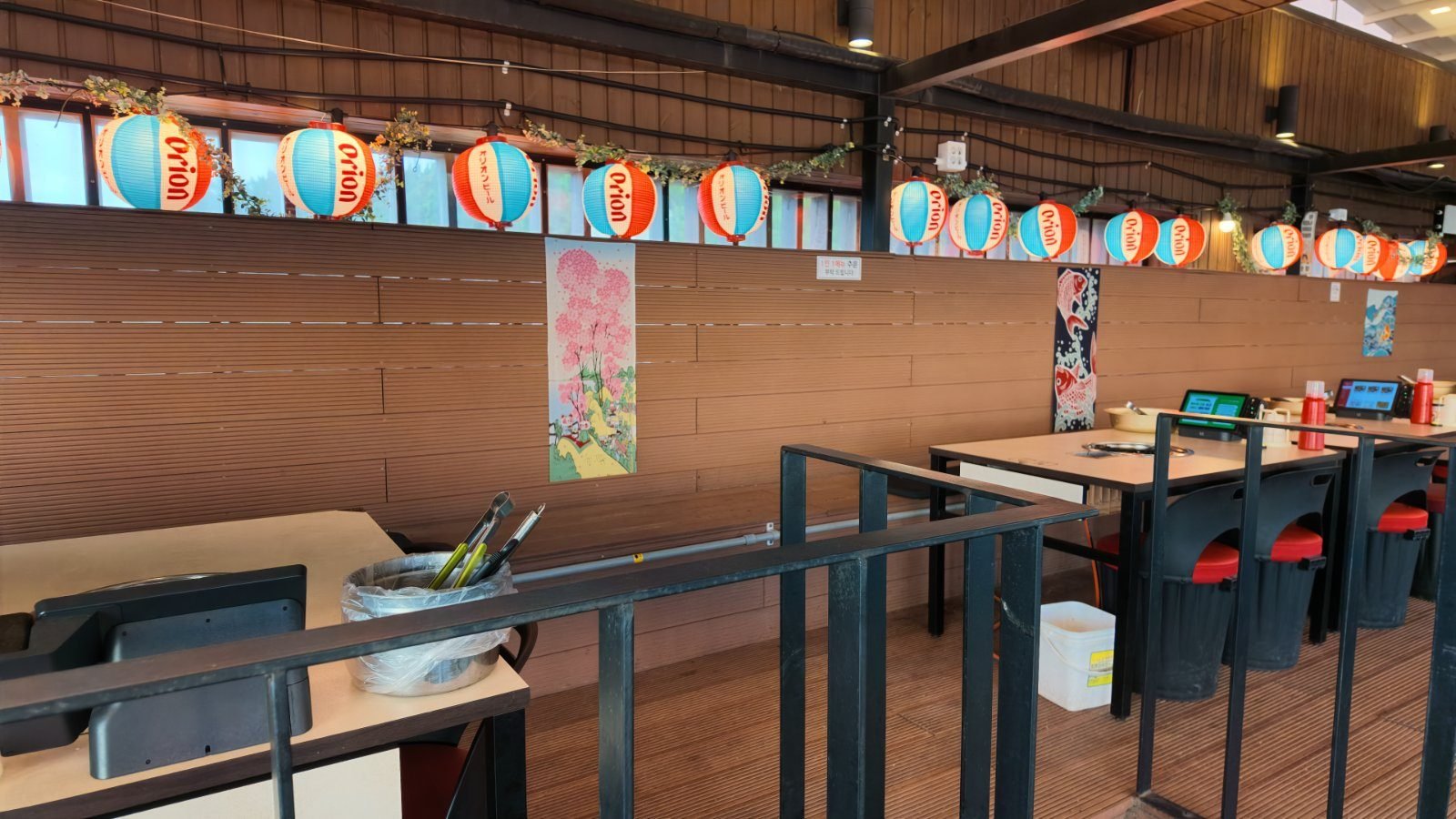
The third floor is glazed along the sea side, so the water is in front of you from the moment you sit down, and the roof terrace is open above it. A poster by the entrance claims this is one of the country’s three great ocean-view restaurants, which is the kind of thing posters say — but the view is genuinely the whole west channel, and Yeongjong sunsets are the good kind.
That does mean timing matters more than it would elsewhere. Arriving in the dark gets you the same food and a black window. If your connection lands you here in the late afternoon, take the terrace. If it’s a midday layover, you’re coming for the pot, not the water, and that’s a fair trade — but go in knowing it.
For a beach you walk on rather than look at, Masian Beach and its mudflats are a different kind of afternoon twelve minutes from Terminal 1, and the ocean-view café at Masian is the coffee-and-window version of this trip if you don’t want a full meal.
Who this is for
Go if you have six hours or more, you’re travelling with someone, and you want one proper sit-down meal rather than three quick ones. The set is built for two and the clam pot is not a solo portion — eating alone is completely normal in Korea, but this particular dish isn’t the one to do it with.
Skip it if you’re tight on time, if you’re travelling with a suitcase you’d have to drag up a lift into a restaurant, or if shellfish isn’t your thing — take the clams out of this meal and you’ve made an expensive trip for noodles. And skip it if you can’t eat chilli at all: the mild octopus is manageable, but it is still a chilli dish.
Practical details
The address is 인천광역시 영종구 잠진도길 55 3층 — copy that into Naver Map and it will route you. The restaurant name to search is 또만나 조개수산. Use the Google Maps pin for Ttomanna Jogae Susan to see where Jamjindo sits relative to the terminals, then switch to Naver Map for directions and opening hours — Naver is the one Korean drivers and buses actually run on, and it’s the only one that will give you a live answer on whether the kitchen is open today. Check the hours there on the day you fly; a restaurant this far out on the island is not somewhere to arrive on a guess.
Questions
How far is Ttomanna Jogae Susan from Incheon Airport?
Eleven minutes and ₩9,000 by taxi from Terminal 1, covering 7.3 km. From Terminal 2 it’s 18 minutes, 18.7 km and ₩17,400. The Muui 1 bus from Terminal 1 platform 7 takes 29 minutes door to door for ₩1,200.
Can I order without speaking Korean?
Yes. Ordering is done on a tablet at your own table with photographs of every dish, so nobody takes your order verbally. The two dishes to look for are 조개폭탄 칼국수 (clam kalguksu) and 불쭈꾸미 (grilled octopus).
Where is the entrance?
Through the Daily Celeb bakery café on the ground floor, then up in the lift. The restaurant occupies the third floor and the roof terrace; there is no separate street door for it.
Is the food very spicy?
The octopus is a chilli dish, but the mild level (보통맛) is properly mild and mixes into rice at a comfortable heat. The clam kalguksu isn’t a chilli dish, so there is always something on the table for someone who can’t eat spice.
Is it worth it on a six-hour layover?
Six hours is the floor, and it works because the drive is short rather than because the meal is quick. Allow an hour at the table — the pot cooks while you eat and rushing it defeats the dish. Under six hours, eat closer to the airport instead.